

By Calliope Wall, Staff Writer
Parents, teachers and policymakers have long debated whether schools should start later. The question is based on growing research that shows early morning schedules are not aligned with adolescent sleep cycles. For middle and high school students especially, a later start time can lead to better physical and mental health, stronger academic performance and a more balanced school day.
The solution to this problem may seem simple for some — if you have to wake up earlier, just go to sleep earlier — but the reality is more complex than that. Most students have significant commitments after the school day. They participate in after-school activities (such as sports, clubs or jobs), commute home (which could take up to an hour), spend hours doing homework and take care of additional responsibilities before they can go to sleep.
What the Research Shows
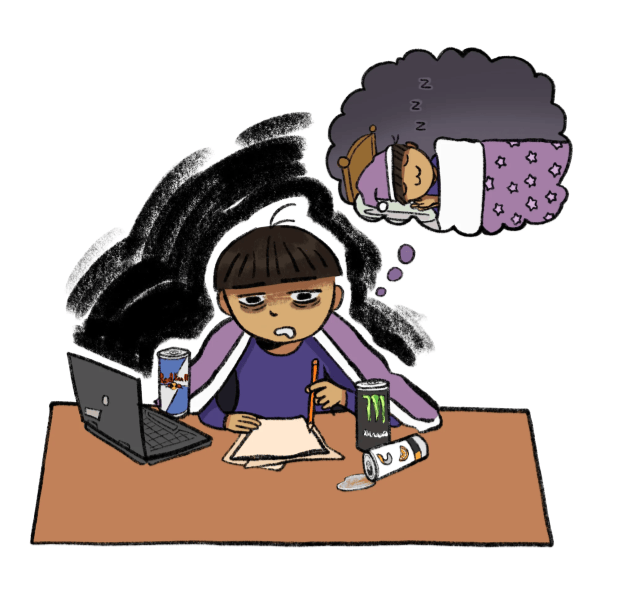
A recent survey at Payton has found that students average six and a half hours of sleep per school night. The data points to the shortage of sleep being partly driven by the nearly 90% of students waking up before 7:00 in order to commute to school and make it before the 8:00 start time. Because Payton students come from all over the city, one student may have a commute time of ten minutes, while another student may be commuting for over an hour. When students have to wake up early to get to school, the time they go to sleep has to get earlier.
Evidence shows that teens getting less than eight hours of sleep reported significantly higher depression symptoms, greater use of caffeine and a greater risk of substance misuse. Additionally, academic performance outcomes show significant positive improvement with the later start times of 8:30am or later. Students who started school later achieved better averages of grades earned in core subject areas of math, English, science and social studies, plus performance on state and national achievement tests, higher attendance rates and reduced tardiness.
Finally, the number of car crashes for teen drivers ages 16 to 18 was significantly reduced by 70% when schools shifted start times from 7:35 to 8:55.
The results from a three-year research study conducted by the University of Minnesota with over 9,000 students from eight public high schools in three different states reveal that high schools that start at 8:30 or later allow for more than 60% of students to obtain at least eight hours of sleep per school night, as opposed to Payton’s average of six and a half hours of sleep.
This posits the idea that if Payton were to push back its school start time (even by 30 minutes), students would get the recommended amount of sleep, yielding countless benefits.
Backed up by Science
Early school start times don’t match the biology of teenagers. During adolescence, circadian rhythms naturally shift later. This means that melatonin, the hormone that signals sleep, doesn’t rise until later at night. As a result, many high school students struggle to fall asleep before 11 p.m.
When a school start time is set at 8:00 a.m. or earlier, teens are forced to wake before their bodies are ready. The result can be chronic sleep deprivation, which leads to grogginess, mood challenges and slower reaction times. One anonymous student at Payton shared that she notices students “go through the school day drowsy and half awake.”
The American Academy of Pediatrics, the Centers for Disease Control and Prevention and the American Medical Association all recommend that middle school and high school classes begin no earlier than 8:30 a.m. These organizations recognize that adolescent sleep needs are different from younger children’s, as Payton should do.
Countries such as Finland and the U.K have top ranked education systems globally, and notably have school start times of 8:30, 8:45 or even 9:00. Policymakers around the United States are also beginning to listen. California was the first state to mandate later school start times for high school and middle school, and Florida soon followed.
Caffeine Consumption
A recent survey found that 37.5% of students at Payton consume over 100 milligrams of caffeine at least one day a week on average. While this may seem harmless, doctors worldwide highly recommend ages 12-18 consume less than 100 milligrams of caffeine a day. The average energy drink easily exceeds this number, with popular ones such as Celsius and Alani Nu containing 200 milligrams of caffeine.
“Caffeine-containing foods and beverages can have effects on the body and mind that interfere with every aspect of what children need to thrive,” said Columbia pediatrician David Buchholz, MD.
Consuming caffeine not only interferes with the development of children including acquisition of skills, and emotional and social well-being. It can also instigate side effects that may have long-term health consequences. If a child also has underlying health conditions, such as high blood pressure, chronic kidney disease or anxiety disorders, caffeine can have irreversible effects.
Even students who do not have underlying health conditions and are consuming over 100 milligrams of caffeine on a regular basis can experience many short term side effects. This includes but is not limited to anxiety, dehydration, increased heart rate, insomnia, jitters, nausea and most prominently restlessness.
Long term use of caffeine can lead to caffeine addiction, and later withdrawal when the child stops or reduces caffeine consumption. Common withdrawal symptoms can include headaches and agitation. If school is pushed back to a later time, students won’t have to consume caffeine on a regular basis.
So Why Not?
While the data is heavily in favor, there are also many common concerns to switching the school start time. This largely includes transportation logistics, after-school sports and family schedules.
Many parents would find it challenging to be at work on time if both the start and the end times were pushed later. This alteration in dismissal time will also have an effect on students who work as well as students who need to take care of their younger siblings.
But experience shows these challenges can be managed. Districts that moved to a later school start time report that activities adjust without collapse. Sports schedules shift, parents adapt and in many cases, transportation costs level out.
Many students at Payton agree that the positives would hold more value. One anonymous student even said that “if school were to start later than 8:00 a.m., there’d be a HUGE positive outcome.”









Leave a Reply