

By Madina Bakhodirjonova, Staff Writer
Writing about mental health, representing diverse characters, discussing grief or political oppression or societal pressures regarding conformity to an unquestionable set of regulations has brought controversy into ideals of creative expression in a modern America.
Oct. 4 marked the beginning of Banned Books Week, an observance on the limits placed on intellectual liberty and celebrating the free expression of thought as cultivated by the privilege to read books of our choosing. It was first implemented by the American Library Association in 1982 during a particularly heated political climate inflamed by practices of mass censorship in school libraries nationwide. This year’s theme, “Let Books Be. Protect the Freedom to Read,” is a tip of the hat towards months of advocacy efforts, library closures, school walkouts and books missing off their usual shelves throughout the nation.
As someone who currently has the honor of being able to work with teen librarians at the Harold Washington Library and the Sulzer Regional Library (one of the four cardinal Chicago Public Libraries), I have observed time and time again how our local libraries remain focal points of Chicago civic life. They serve as a few hours of relief for the exhausted mother during story hour, a creative escape into the world of DIY and craft-making for the artsy tween, and a place to go for ESL and resume building lessons for the immigrant father bringing two giggling kids who race each other to the graphic novels section the first chance they’re out of Dad’s grasp.
So frequently do teenagers like us stop by after school, sometimes with friends, sometimes by themselves, seeking somewhere fun or maybe somewhere quiet to let thoughts flow out with a few acrylic strokes on a t-shirt, an embroidered patch on a pocket, humming with headphones in, head down, eyes so sharp, then crinkled with pride as they hold up a personal statement on a white tee.
Besides their role as community resource and service centers, libraries are one of the few places that are not actively trying to use or sell information about their patrons, something we would be hard pressed to find in an increasingly surveillance-based economy. When one walks through the doors of their public library, they are instantly enveloped in the hospitality and ambient peace that a space of books and free thought radiates. In the summertime, laughter from Jenga games, families coming in to take free museum passes and bird-watching groups getting ready for an expedition around the neighborhood can be overheard. During the winter, it is the clack of chess pieces, muffled laughter from the baking class and book clubs next door and the swish and shudder of the new patron as they step in with snow-covered boots and frosted lashes, the flickering warmth of wood-paneled shelves already seeping in. These are places that have touched the life of each and every Chicagoan, and to those who visited more than once, that seem to have a breathing sentience of their own.
It is a sign of privilege when an individual is able to respond, “But can’t you just buy books?” to the book ban dilemma plaguing American schools, homes and libraries in the 21st century. Not all homes have the means to pay for the enjoyment of art and culture, and this gets to the root of the matter when dealing with a socioeconomically diverse society.
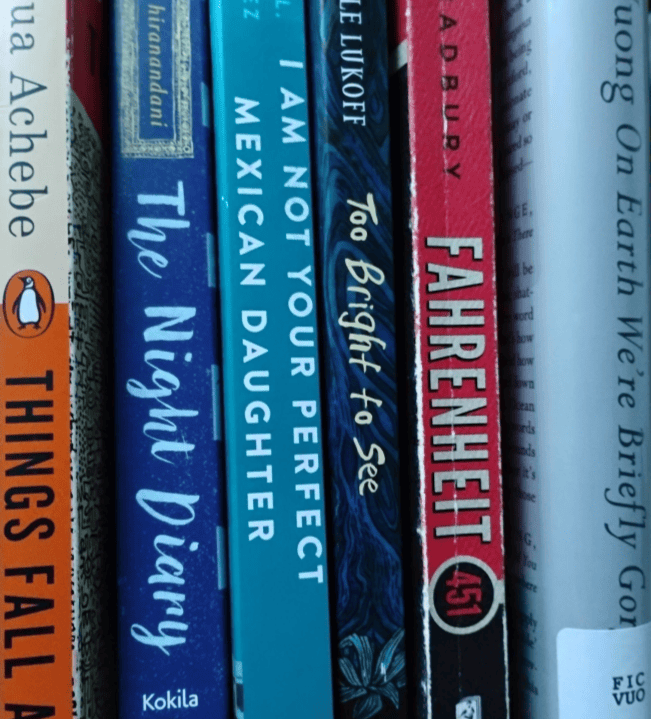
When individuals cannot see how a crisis affecting the wider social sphere could affect their own abilities to exercise rights, they leave the door open for censorship to prevail, fueled by the belief that rights to education are individual and thereby untouchable by targeted policy action. When the rights to a common good are revoked, when libraries are the targets of a sociopolitical censorship regime, all of our rights to expression, argument, protest and congregation are threatened. This is, after all, the timeless lesson of dystopian literature (ranging from the popular – Hunger Games and Divergent – to the classics – 1984 and Fahrenheit 451), a genre particularly targeted by the sort of government action and propaganda so ironically highlighted in their own pages.
This is the lesson of Persepolis, a famously challenged graphic novel in the curriculum of Lane Tech for portraying images of the historical suffering and police abuse undergone by Iranian people in the 1979 Islamic Revolution. It was challenged, among reasons of images of war and revolutionary suffering, for expressing “communist sympathy,” an agenda that was apparently interpreted by the seven-year old protagonist’s struggle to understand ideas of Marxism and democracy expressed by her neighbors and parents over high noon tea gatherings. The book expresses an uneven evolution into adolescence and adulthood as seen in the fragmented form of identity that develops when one’s youth is forced into maturity with early exposure to images of war, suffering, and other modes of human depravity, a repeated cross-cultural history that Western culture normalizes ignoring.
But the students of Lane Tech fought back against this “protective” logic by raising the question, “Why are parents so eager to prevent kids from reading about the same type of conflict and suffering that American generations have inflicted on global communities for decades?” Indeed, the very knowledge that is required to inform the future generations on acting on global issues with diplomacy is denied with bans on historical narratives that provide accounts from those on the other side of political suppression. An account of the protest and backlash of teacher unions and the students of Lane Tech against the removal of Marjane Satrapi’s Persepolis in the first and last CPS book ban (2013) is narrated in full color and fiery prose in the 2026 non-fiction graphic novel Wake Now in the Fire, a current runner for the annual nominated young-adult book list read and recommended by Chicago teens.
Books are not banned simply because a reader disagrees with the nature of the content. If that were true, any reader could be an active censor for the diverse expanse of literature that could go against our own experiences or regarded opinions. Rather, censorship emerges out of a need to centralize a people around a core ideology in a society, and, as mentioned, the emotion, length and logic developed in text contradicting the principles the leadership promotes is seen as something that could endanger a conformity the society is being built around.
Common arguments for book challenges primarily orbit around underage content concerns and that of “unnecessary education” or content that is claimed to be unrelatable, and therefore useless, to students. But too often this can extend to bans on entire categories of thought on issues prevalent in the present world. They can remove representations of mental health, lived experiences of neglect and abuse, stories of grief and recovery – all illustrated in the bans of the novels The Perks of Being a Wallflower, Speak and The Bluest Eye. They give us a real representation of the imperfect human experience, and of being able to live in an imperfect world. Prose allows us to acknowledge these imperfections when conversation fails us in favor of keeping the “safe” comfortably-grey environment.
I would like to close this note by providing students and other readers with a list of books that have been repeatedly challenged in recent years. This is a call for you to exercise your right to read. Use it.
The United States has undergone many civil rights movements that were unfortunately necessary to include any apportionate representation of all groups of people in society. It has gone to some length to represent all your voices, with Amendments protecting the freedom of speech and the freedom of the press, ensuring that articles, like the one you read now, and newspapers, such as the Paw Print, remain just and available forms of representation for all Payton students.
But individuals will choose to continue their radicalization of the ideology of free speech and assert that there exist limitations to what a society should think, prioritize, and base their decisions off of. The very existence of the pen and page has always threatened the looming shadow of political usurpation over academia and the pursuit of knowledge. And it will always do so, whether we choose to buy into a conformative society or not. So, in the spirit of Banned Books Week, pick up a book and own your education for once.
The Big Bad Banned List
* Note: The entire point of going against book bans is to promote your freedom to read. You are entitled to have your opinion on the books you read. The following recommendations are for those who would like recommendations for books from a variety of genres that have historically been challenged or banned in the U.S. There are other notable books that are not included in this list. There are books that contain viewpoints of non-liberal individuals that have been banned. Reading is about expanding horizons. But what you choose to read also falls under your own autonomy and willingness to explore. Happy reading, whichever story you choose.
* For further references, check out the American Library Associations List of the 10 Most Challenged Books, from annually compiled data since 2001.
Containing Topics of Censorship, Revolution, and Political Reformation
- Fahrenheit 451
- Persepolis
- Animal Farm
Portrayal of Mental Health, Topics on Diverse Learning & Ableism, Questioning Respectability Politics
- Perks of Being a Wallflower
- Flowers for Algernon
- The Curious Incident of the Dog in the Night-Time
Portrayals of Diverse Gender and Sexuality Representation, Topics of Adolescent Romance
- Song of Achilles
- Looking for Alaska
Portrayals of Multicultural Individuals & Police Brutality, Questioning Microaggressive Racism
- The Absolutely True Diary of a Part-time Indian
- The Hate U Give
Topics of Sexual Abuse & Victim Fear of Retaliation, Addressing Underreporting, Questioning Gender Representation
- Speak
- The Kite Runner
- The Handmaid’s Tale
Portrayal of Exaggerated Consumerism, Critiques of Modern Social Trends, Controversial Reformation of Society
- Brave New World


Leave a Reply