

By Steven Jiang, Editor-in-Chief
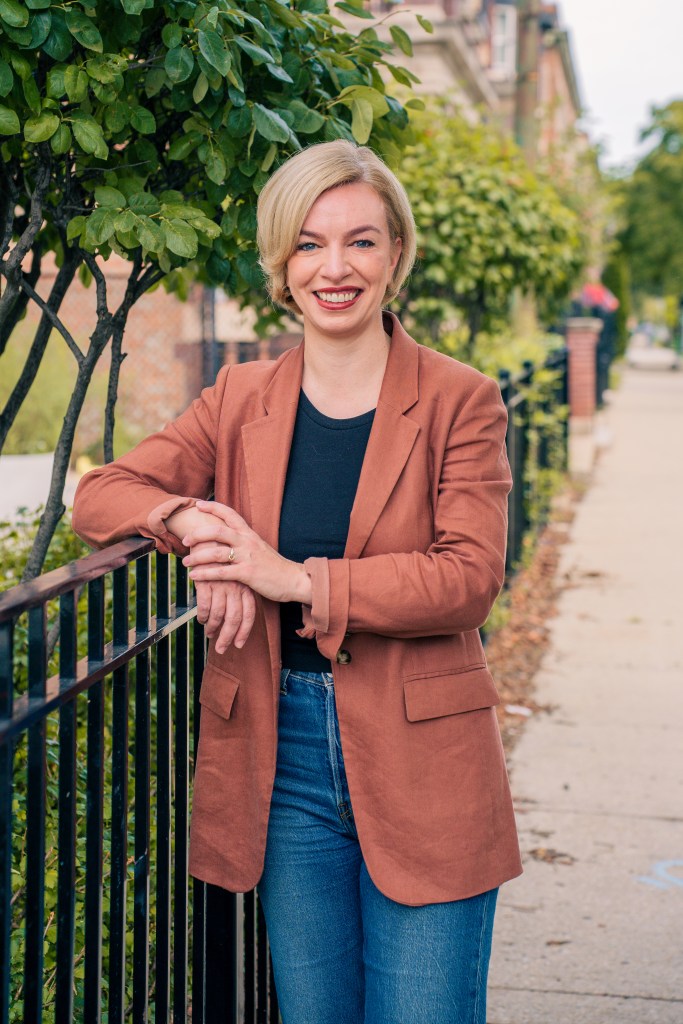
Jessica Biggs has seen it all.
The 43-year-old former middle and high school teacher, embattled principal, current school board member and CPS mom has navigated the convoluted politics of Chicago’s public education system for years. She holds an Ed.M. in school leadership from the Harvard Graduate School of Education and certificates in leadership and education finance from the University of Chicago and Georgetown, respectively. Biggs also leads the Southwest System of Care, a nonprofit that provides community services including benefits assistance and healthcare in six neighborhood schools.
Speaking with The Paw Print, she vowed to serve as a “coalition builder” for the 21-member school board, which has faced skyrocketing debt to the tune of $9.1 billion in 2025. Political pressure from the Chicago Teachers Union (CTU) and the Service Employees International Union (SEIU), both of whom fueled Mayor Johnson’s rise, has exacerbated the dysfunction of CPS. Meanwhile, students across the city continue to lag behind their state and national peers in subject proficiency rates.
In the three-way race for school board president, Biggs has cast herself as moderate compared to CTU firebrand Hilario Dominguez while emphasizing her educational work experience over attorney and self-proclaimed outsider Victor Henderson. She is the only presidential candidate who currently serves on the Chicago Board of Education.
“I’ve spent the last two decades in schools all across the city,” said Biggs. “I know what is possible for Chicago and for our young people when adults can get on the same page.”
Biggs touted her experience leading the CPS CEO search last year, calling it an “extremely instructive” learning moment. She described the process as collaborative and driven by an agreed-upon timeline with clear objectives.
Yet in February, Biggs complained about “blatant political interference” by Johnson’s administration after a list of finalists was leaked to the press, stalling the search.
Eight months later, she has softened her tone. “CPS is better served when there’s a close partnership between the board and the mayor,” said Biggs, adding that the board president should not be “moved by the political interests of the mayor’s office.” She pushed for transparency, diverse committees and equal access to information for all board members.
Biggs’ modus operandi during the CEO selection process offered a window into her leadership style. “Sometimes we think of community engagement as town halls,” she said. “I don’t actually think that’s very engaging.”
Instead, she prefers to engage in “small-group dialogues” with facilitators and note-takers present. Biggs said that her diverse coalition includes “people who have historically been furthest from opportunities” and other stakeholders — many of whom have already made their presence known in the race.
“I have the greatest number and the greatest diversity in endorsements and donors to my campaign,” she said, listing off a plethora of names ranging from former CPS CEO Dr. Janice Jackson to Cook County Board of Commissioners President Toni Preckwinkle. She also pointed to her endorsement from the SEIU, which represents low-wage school support staff.
What Biggs left out, though, was a $150,000 donation in early October that she received from anti-CTU billionaire Michael Sacks, who has since bankrolled 37% of her campaign funds. It reflects a growing trend of interest group rivalries playing out as proxy financial battles. As of Oct. 28, Biggs leads the pack in fundraising with $1,804,212, narrowly edging out Dominguez’s $1,714,595. Dominguez’s campaign is backed by CTU-affiliated political organizations.
Biggs brushed off allegations of loyalty to wealthy donors as a “boogeyman” argument. However, she refrained from commenting on Sacks in particular, only promising to “not be swayed by any one donor” and reiterating her endorsements from unions and progressive leaders.
She further emphasized her experience on the ground in CPS.
Steps away from the Garfield Green Line station on the city’s South Side is Burke Elementary School, which primarily serves Black and Hispanic students. Under her administration as principal from 2012 to 2018, Biggs led the school from probation to Good Standing status. But this uptick in rating carried controversy. The district’s inspector general accused Biggs of meddling with attendance records by marking students as “tardy” instead of “absent” and arranging student transportation in staff vehicles. She was fired by CPS and placed on the Do Not Hire list.
Biggs dismissed the scandal as a “minor bureaucratic issue,” contending that her firing was political retaliation for speaking out against special education funding disparities and an Aramark janitorial contract. After three unsuccessful lawsuits, she finally cleared her name from the blacklist in July 2025. She denied using her influence as a board member to secure the appeal.
Beyond the firestorm, though, Burke remains a school where only 12% of students are proficient in English and 10% in math, according to ISBE data from 2025. Biggs proposed increasing funding for early childhood education to boost reading and math outcomes across the district.
“Investing in robust literacy and math instruction at those grade levels pays dividends,” said Biggs. “I’d like to see… every second grader moving to third grade, ready to read and learn.”
Biggs supported a moratorium on AI use in the classroom until the district draws a clear line distinguishing “intentional supplements to learning” from “substitutes.” She further raised concerns about high screen time for young children.
Burke’s challenges are far from an anomaly in CPS. But on the opposite end of the spectrum, students at the district’s flagship selective enrollment schools, including Payton, outperform their peers by significant margins. Like many Chicago parents, Biggs supports school choice — her daughter currently attends a magnet school. In fact, 44% of elementary school students and 76% of high school students do not attend their zoned schools, according to district data.
In 2025, selective enrollment schools received $16,953 on average in funding, compared to $19,798 for the district. Biggs described the funding situation as a “Hunger Games competition for resources,” adding that “no one has enough currently.”
However, she justified Payton’s relative lack of funding through CPS Opportunity Index, the formula that aims to equitably distribute resources and prioritize high-need schools. She also cited Payton’s external revenue from its wealthy donor network, which raised $884,987 through Friends of Payton last year.
“School communities that have more significant needs should have more resources coming from the district,” said Biggs.
To secure this funding, Biggs vowed to implement a five-year financial recovery plan in collaboration with City Hall and community partners. Her primary objectives are obtaining “at least two months of cash on hand so that we’re not needing to borrow to make payroll” and restoring the district to an investment-grade bond rating. Currently, Standard & Poor’s rates CPS bonds as BB+ negative, a “junk” designation that forces the district to pay higher interest rates to compensate for the risk of default.
Biggs criticized interest payments on debt for “diverting resources away from the classroom.” She also cited her vote against the controversial budget passed in July, which assumed $150 million of disputed state funding that has yet to be secured.
“We learned in this year’s budget cycle that about $0.59 of every dollar actually goes directly to a school,” Biggs claimed. The Paw Print could not independently verify this figure. According to the CPS Budget Overview for Fiscal Year 2027, 62.2% of the budget is allocated for district and charter schools. Biggs singled out “administrative expenses” for additional scrutiny, but they constitute only 4.4% of total funding. The remaining 33.5% pays for citywide resources such as custodians, nurses and funding adjustments for individual schools.
On closing schools to cut costs, Biggs rejected any measure resembling the mass shuttering of 50 CPS schools in 2013, the largest in American history. “I was a principal at a neighborhood school on the South Side in 2013 that was on the list to be closed all the way until the final 50 were announced,” recalled Biggs, emphasizing the “tremendous harm” perpetuated upon predominantly low-income communities.
Another frequently cited figure regarding operational efficiency is that less than 70% of seats are filled in 255 of 476 CPS schools amid declining enrollment. While Biggs did not explicitly back consolidation of underutilized schools, she refused to rule it out either. She expressed support for “having authentic conversations with communities about how the district needs to organize itself to provide the educational experiences that families are seeking.”
According to Biggs, having a daughter in the district is her stake in “making sure that this system is set up for long term success.” She hopes that her track record will be defined by constructive leadership, not misconduct allegations. Her carefully curated image is that of an insider with the experience to reform the system without entrenching herself in establishment politics.
Chicago’s voters will have the final say on Tuesday, Nov. 3 when they elect a new leader to oversee the nation’s fourth-largest school district. No clear frontrunner has emerged among the three candidates, and early voting is already underway. Payton students who are 18 years or older on Election Day can register to vote online.






Leave a Reply