

By Zuzanna Dabrowski, Copy Editor
Growing up, the world limited the definition of “real careers” only to those in STEM. Choosing to study history, literature, philosophy, religion or art would not lead to a stable career. Writing and reading were only hobbies, while math and science supposedly prepared students for the future.
“I cannot tell you the number of students who tell my team daily that despite their passion for the humanities, they will most likely be majoring in a STEM field due to concerns about job prospects,” said Jin Chow, a former contributor to Forbes magazine. He goes on to say in his article “Myth Or Fact?: STEM Majors Are Inherently More Valuable Than Humanities Majors” that “I myself have been the recipient of many such pieces of well-intentioned advice earlier in my academic journey.”
This unfortunate reality is a common occurrence. It provokes the question: why do people actually believe STEM is more important than humanities?
According to David Demming, an economist writing for The New York Times, many college students choose to major in STEM because of the immediate benefits. In his article “In the Salary Race, Engineers Sprint but English Majors Endure,” Demming states, “The conventional wisdom is that computer science and engineering majors have better employment prospects and higher earnings than their peers who choose liberal arts.”
Demming also says that “since new technical skills are always in high demand, young college graduates who have them earn a short-run salary premium.” Especially in this era, the importance of technology among other STEM paths is most crucial.
Although STEM does tend to be more successful in the short run, humanities catch up to them in the long run. According to data from the National Humanities Alliance, STEM careers have a higher salary with fewer years of experience (0-5 years) than humanities careers. However, humanities careers have the same or higher salary than STEM careers when it comes to more experience (10-20 and 20+ years in the industry, respectively). It is hard to believe that so many people can be near-sighted in the way that immediate, short-term success is above a job with delayed gratitude but success nonetheless.
A blog from Southeast Missouri State University shares why students might tend to be drawn towards choosing a career in STEM. The blog discusses how “financial considerations play a significant role, as STEM occupations often offer higher starting salaries and stronger job security than other occupations.” This blog, titled “STEM vs. Humanities: Choosing Your Degree Path,” continues by saying that “the technology sector’s rapid growth creates abundant opportunities for skilled professionals. Many students find satisfaction in solving concrete problems and seeing tangible results from their work as well.”
It has not always been this way. After all, what is humanity without the humanities? The shift toward STEM has deprioritized these fields of study and led to more people choosing to work in a field solely based on their perceived notions of success. So many young people have already begun to think this way about future careers, but experts and those in humanity based fields are worried about the dangers of losing aspiring humanities majors.
“Now, the economic state of the world is not lost on me, and I would never shame someone for wanting to pursue higher education solely for the purposes of raising their chances at a higher income. That is a completely valid choice to make,” says Morgan Parker in their article “Has STEM Led to a Loss of The Humanities?” for Medium. “I just fear that STEM degrees are now seen as the only valuable degrees to have. We cannot exist in a world without the humanities. Without history, art, and language, we are nothing more than mindless robots stuck in the machine of corporate America.”
Maia Gibson, a news editor for the University of Indianapolis’ newspaper The Reflector, discusses the dangers of cutting humanities from universities and in her article “Focus on STEM detrimental to humanities.” Gibson reflects on the importance of each field, mentioning how “we need the human element that English and history provide through literature and learning about the past.” They highlight the field’s uniqueness by stating “no one of these fields are the same, and removing any of them from an education eliminates an entire skill set, understanding and an opportunity for growth.”
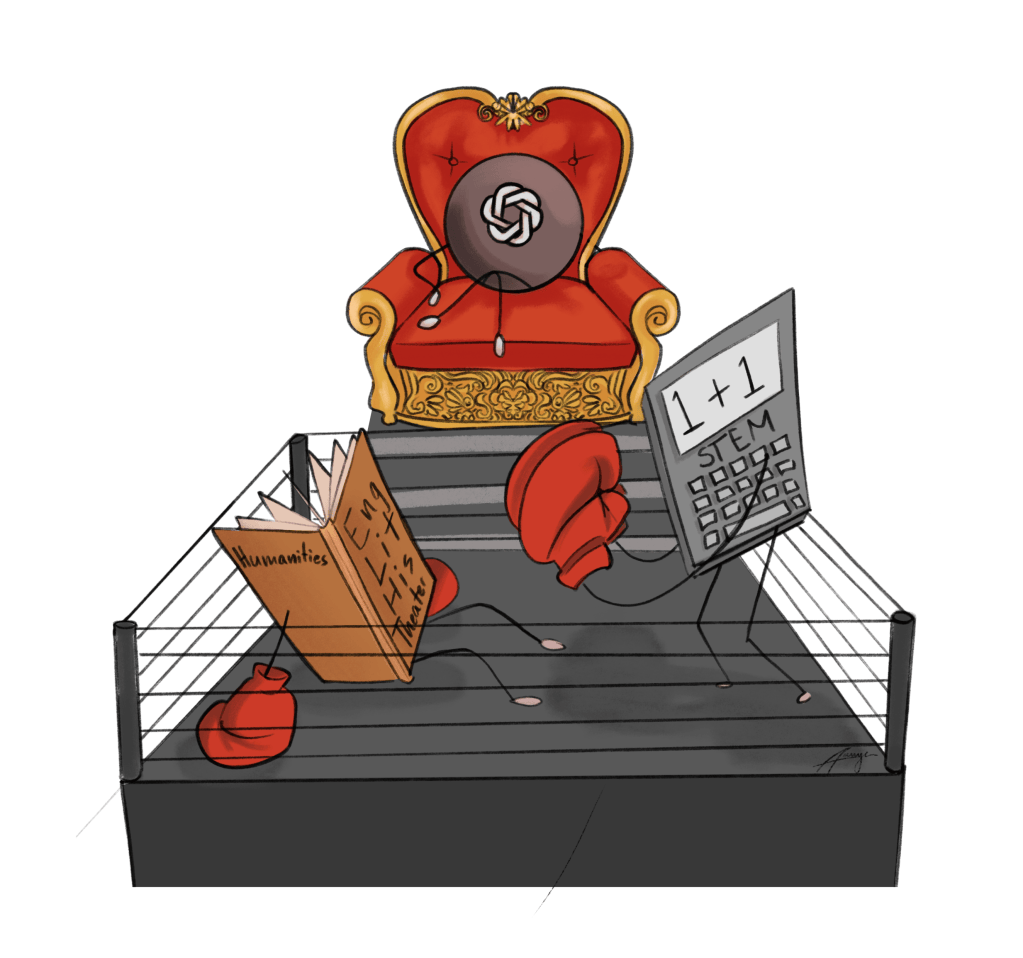
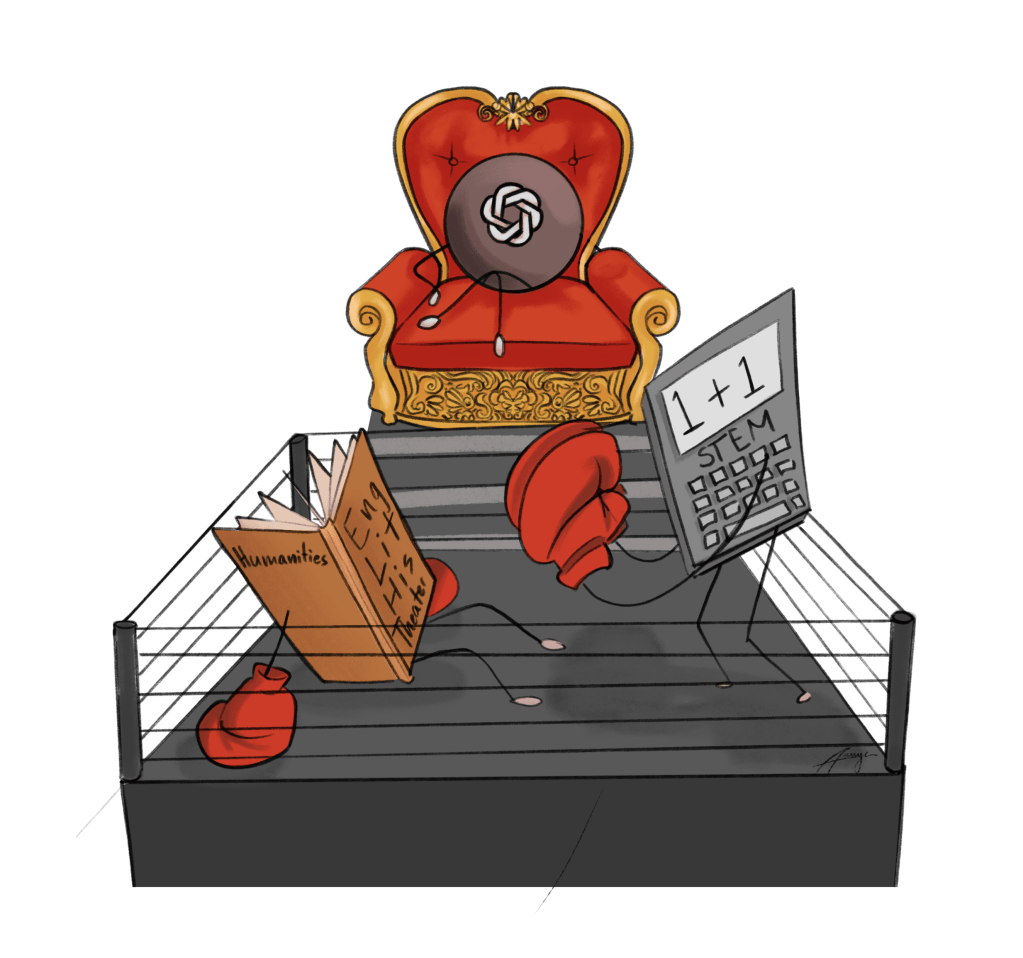
The world needs both STEM and humanities, and they both create important and meaningful careers. Despite this, we have to fight so that people treat these fields with equal importance and value. This fight will now include a new changing technology that has been rapidly evolving only in the last 5 years or so: artificial intelligence.
AI threatens all jobs, but what is shocking is how people believe that AI will never replace the humane parts of the world. “What it is like to be us, in our full humanity—this isn’t out there in the interwebs. It isn’t stored in any archive, and the neural networks cannot be inward with what it feels like to be you, right now, looking at these words, looking away from these words to think about your life and our lives, turning from all this to your day and to what you will do in it, with others or alone,” says Graham Burnett, a professor at Princeton University, in their in-depth article “Will the Humanities Survive Artificial Intelligence?” published in The New Yorker. “That can only be lived.”
In summary, the humanities are what it means to be human. AI could never replace them, because it will always be a machine. It can describe emotions, but it will never be able to experience them the way that humans can.
What about STEM careers? Alisson Sylte writes about this in their article “How will AI impact the job market?” for Colorado State University. Citing a study and report from McKinsey Global Institute, Sylte says, “According to one study, roughly half of our jobs could be done by existing automation technologies. Meanwhile, the STEM fields that were considered some of the safest careers in the not so distant past are now thought to be some of the most vulnerable to being replaced by artificial intelligence.“
The most ironic part about this is how, for a while, everyone believed that this new era of technology would lead to STEM careers prospering. Now the very creation of people in these fields is threatening their jobs. Although there is still a huge gap between students pursuing STEM and the humanities, the latter may be the only one to survive this AI epidemic.




Leave a comment