

By Steven Jiang, Editor-in-Chief
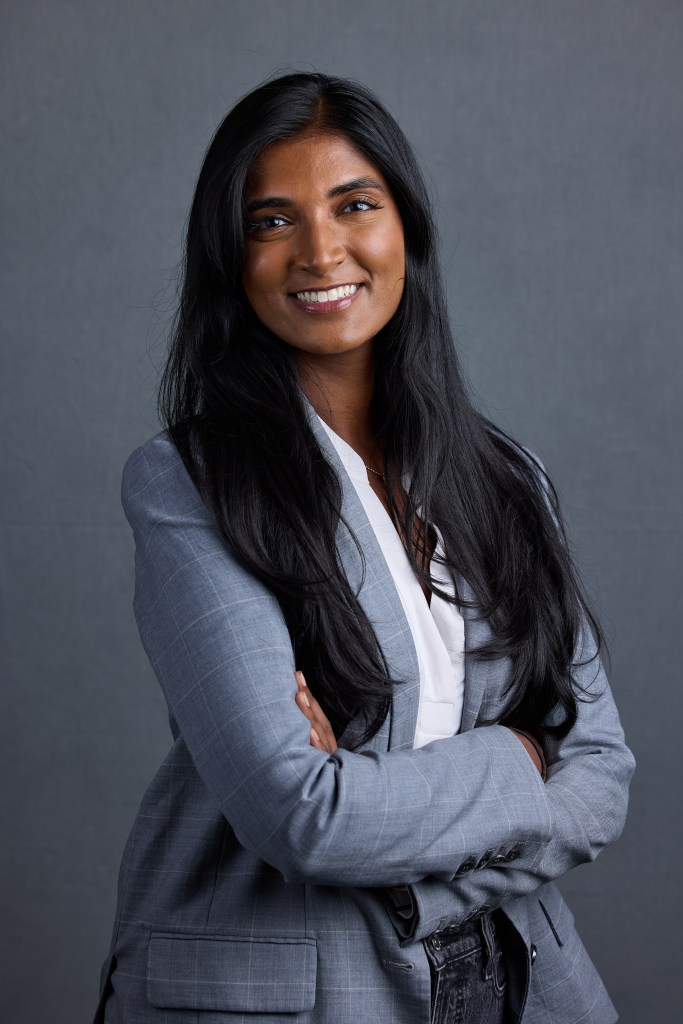
“I have a track record of not taking no for an answer,” declared Anusha Thotakura. She is the 28-year-old incumbent representing District 6A, which includes Walter Payton College Prep, on the Chicago Board of Education. Originally appointed by Mayor Johnson in 2024, she now faces a three-way race to retain her seat on the city’s first fully elected school board.
The former middle school math teacher graduated from Fremd High School in Palatine before attending the University of Illinois at Urbana-Champaign, where she majored in economics and political science. After earning a master’s degree in public policy from the Harvard Kennedy School, she eventually returned to Chicagoland and campaigned for several local Democratic politicians. Today, Thotakura leads Citizen Action Illinois, a progressive lobbying group that supports collective bargaining, universal healthcare and campaign finance restrictions.
In an interview with The Paw Print, Thotakura laid out her pitch to the district’s voters, seeking to distinguish herself from her opponents. Both former special education teacher Isaiah White and Dr. Brenda Lee Anderson, a former Northwestern education policy lecturer, are vying for the seat that serves Streeterville, River North, Near North, West Town and Wicker Park. “I know what it’s like to be tasked everyday with doing the impossible, which is showing up for students who have the odds stacked against them,” Thotakura said. “I did that every single day as a classroom teacher and now I bring that fight as a school board member.”
The 21-member board oversees Chicago Public Schools and has the power to levy property taxes, set the budget, select the leadership and approve contracts. The district’s ballooning debt, which hit $9.1 billion in 2025, has fueled turmoil over the past few years. In 2024, the entire board resigned amid a fallout between CPS CEO Pedro Martinez and Mayor Brandon Johnson, who demanded a short-term high-interest loan for $300 million. This July, Thotakura voted for a budget that assumed $150 million in disputed funding from the state — which has yet to be secured. The measure narrowly passed by an 11-7 margin.
Thotakura doubled down on her decision, citing Illinois’ Evidence-Based Funding (EBF) system adopted in 2017, which aims to rectify disparities in property tax revenue across school districts. Mayor Johnson’s allies have argued that the state owes the district $1.6 billion assuming a 100%-funded CPS, although over 66% of districts across the state also currently fall short of the state’s explicit 90% funding target.
This year, CPS was 70% funded according to the formula, which Thotakura correctly noted. She blamed Springfield for not appropriating enough money under the legally binding EBF model, accusing politicians of “shrinking our budget year after year and then questioning why it’s harder for students to succeed.”
The Education Law Center estimated in 2024 that Illinois would have to increase funding by $2 billion each year to meet the targets. That number has likely increased since then, with few politically feasible resolutions in sight for the near future.
But Thotakura remained optimistic about alternative funding mechanisms. She mentioned a $768 million payout from a Meta settlement with the state over teen social media addiction. “[Springfield] can’t make money appear out of thin air,” she said, “but we do have to look at what revenue sources could be.”
Thotakura further lamented that schools have increasingly relied upon “private funding for basic services.” Payton, which secured $884,987 in revenue through Friends of Payton last year, stands as an anomaly in CPS. Across the city, parent organizations have struggled to keep up with rising infrastructure improvement costs and employee salaries.
“What I believe is incredibly reckless,” Thotakura said, “is to continue cutting funds from our schools year after year after year without engaging state lawmakers to ask them to…fund our schools.”
As a frequent traveler to Springfield, Thotakura pointed to her Citizen Action Illinois experience of lobbying directly to legislators, whom she often invites to join her during school visits. “The work that I do as a board member may look different, but it’s in the same spirit,” she added.
However, she conceded that if the $150 million never materializes, she would accept a potentially turbulent mid-year hiring and spending freeze.
Thotakura claimed to follow independent judgment when making decisions on the board. But she is familiar with the powerful players within Chicago’s educational system, including two major labor organizations: the Chicago Teachers Union (CTU), the sole bargaining mouthpiece for over 30,000 educators, and the Service Employees International Union (SEIU), which represents custodial staff, security officers and classroom assistants. While the CTU advocated for this year’s controversial budget, the SEIU voiced concerns about fiscal discipline. These interest groups, in addition to wealthy independent donors, have already contributed over $6 million to school board candidates this year.
Thotakura, who is one of only five candidates citywide endorsed by both the CTU and the SEIU, said that she is intentional about the stakeholders she surrounds herself with. While acknowledging the influence of union endorsements, she maintained that her primary focus was engaging “school leadership, LSCs, parents and community members.”
“Those relationships take time to build,” said Thotakura. “People trust you and are willing to give you the support, the information [and] the resources that you need to be able to advance your work.” She highlighted her work on the Healthy Green Schools Resolution to justify her incumbency advantage. The board unanimously approved the guidelines last year, which mandated expansion of clean energy technologies in 12 neighborhood schools.
As CPS subject proficiency rates continue to lag behind state averages, Thotakura expressed concern that children are being left behind. She described the crisis as a systemic issue that continues through primary and secondary schooling, where “cracks and gaps in learning start to surface and only compound.” Thotakura recalled that some of her middle school math students had not mastered foundational skills.
According to her, one solution is to fund universal pre-K. “On the first day of kindergarten, a teacher could tell you with confidence which students attended pre-K and which ones did not,” she said. “The fact that pre-K access is so deeply tied to household income is also an equity issue. So many pre-Ks at CPS, especially in my district…[have] a long waitlist.” For older students, Thotakura proposed hiring interventionists to rectify individual gaps in learning.
While acknowledging the personalized services offered by online platforms such as Khan Academy, Thotakura warned against the “mass proliferation of AI” in education. She expressed concerns about student data privacy and called for safeguards against other potential harms. But she remained open to its use, provided that the district refines its AI policy and scrutinizes contracts with technology companies.
Thotakura presented a nuanced view of school choice, which has dominated public discourse ever since the board approved a five-year plan, Together We Rise, that prioritized investment in neighborhood schools. Contrary to misinformed rumors, the plan did not call for divestment from selective enrollment schools. Yet district data confirms that 44% of elementary students and 76% of high school students do not attend their zoned schools.
“Students in District 6A have very different experiences, from Walter Payton to schools like Manierre, Sabin [and] De Diego, which serve very high-need students,” Thotakura said.
Though she would consider magnet and selective enrollment expansion, Thotakura defended Together We Rise’s funding strategy. “You look at the resources and programming and offerings at different high schools across CPS and it is no surprise why not every family is excited to send their children to a neighborhood school,” she remarked.
It is worth noting that selective enrollment schools receive less funding compared to the district average. Last year, the figures were $16,953 and $19,798, respectively. In addition, over half of the district’s schools operate below 70% capacity, most of which are neighborhood schools. While critics claim financial inefficiency, moratoriums on school closures and intense political pressure have kept their doors open.
Thotakura criticized the utilization formula for not accurately representing the situation on the ground. “A school that may be ‘underutilized’ on paper,” she said, “but if there’s a school that wants to utilize those spaces in different ways…then our utilization formula should reflect that and not make it look like the school is empty and collecting dust and cobwebs. That is simply not the case.”
While opposing the consolidation of underutilized neighborhood schools, she suggested that they could rent out spaces to community partners and expand school-based health centers, which provide immunizations and checkups for community members.
The election on Tuesday, Nov. 3 will serve as the final referendum on Thotakura’s tenure. Payton students who are 18 years or older on Election Day can register to vote online.







Leave a Reply