
By Sanaa Taqvi, Staff Writer
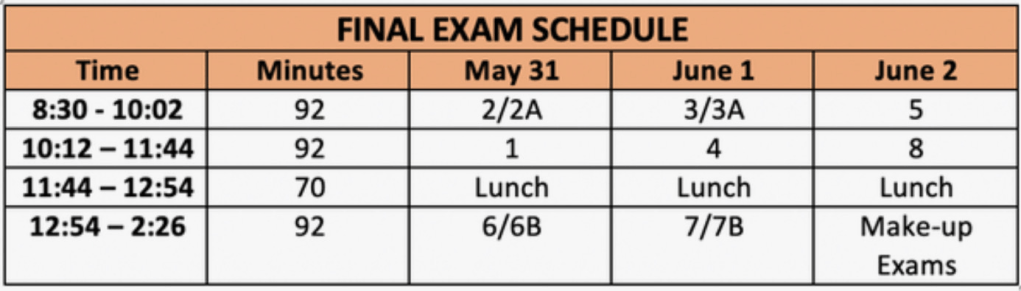
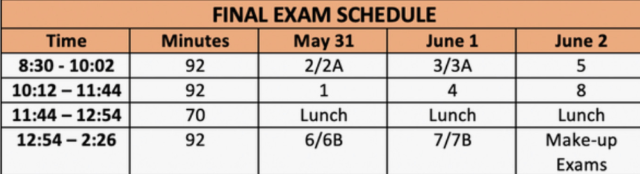
The semester 2 finals schedule for the 2022-2023 school year.
With the final week of AP exams coming to a close, Payton students should finally be able to kick back and cruise through their last month of the 2022-2023 school year, but as they turn the corner into the remainder of the year, final exams lurk in the very near distance.
In prior years, the dreaded finals week has been horrifyingly inconsistent. The COVID-19 pandemic, which hit at full force during the 2019-20 school year, disrupted the education system and created an environment where it was difficult to administer accessible, and academically honest exams. This resulted in having limited, to more commonly, no exams during this period. This trend continued into the 2020-21 school year. Last year, following the Chicago Teachers Union strike, and the corresponding lost teaching days, semester 1 finals shifted to no-harm. Semester 2 finals were also no-harm to a great extent.
This year, an entire generation of Payton College Prep students face their first official finals week with no guidance, studying tips, or experienced students to turn to for advice regarding how to navigate this week. As a result, many students support the “no-harm finals” approach, including the rising StudGov President Anoushka Lal ‘24.
A survey from Inside Higher Education divulged that seven out of ten teenagers felt that anxiety or depression was a significant issue in school communities, with three-quarters describing themselves to be in a constant state of stress. When asked about their opinion of finals week, many students at Payton stated that harm-finals create an atmosphere of unnecessary stress and anxiety. They furthered this opinion by asserting how they felt that their self-worth was called into question, especially taking into consideration the competitive Payton culture.
Traditional final exams often favor students who excel in high pressure test-taking situations while disadvantaging those who suffer from test-anxiety, stress, or students who are simply having an off day. By adopting the no-harm finals approach, Payton could create an environment that prioritizes student well-being. The removal of the potentially detrimental consequences to one’s grade serves to foster a healthier mindset, and enables students to enter exams with confidence and embrace learning as a positive experience opposed to a stressful one. The focus of learning should not be purely based on memorization and regurgitation of information, but rather allowing students to expand their critical thinking and problem solving skills. By exploring topics in greater depth, students gain a comprehensive understanding instead of simply attaining a letter grade. There have been times when I have felt as though I have engaged with a course material meaningfully but have walked away with a letter grade that I felt did not reflect the actual knowledge and skills that I obtained over the course of the year.
Implementing the no-harm approach challenges educators to create alternative methods to assess a student’s learning. This opens the door to a wider variety of evaluative tools, including projects, presentations, and collaborative assignments. Not only do these methods assess a student’s learning, but they also challenge students to apply what they have learned and prepare for the real-world. This, in turn, can allow educators to create a more comprehensive and accurate evaluation of a student’s overall progress.
In the real world, success is not measured by a letter on a piece of paper. Rather, success is determined by a multitude of factors including adaptability, collaboration, and resilience. By implementing no-harm finals, students are given the opportunity to develop these essential skills and prepare for the challenges that they will face beyond academia.

![[Photo Gallery] Homecoming Football Game Payton vs. Brooks](https://paytonpawprint.com/wp-content/uploads/2026/03/img_4761.jpeg?w=1024)

 The Paw Print
Leave a comment