
By Marek Cherian and Daniel Garin, Staff Writers

Walter Payton College Prep is one of the most prestigious high schools in the United States. Ranking fifth nationwide and first in Illinois, it is no surprise that it offers many impressive and rigorous courses. From AP Human Geography to AP Physics, students are free to push themselves to their full potential. However, among the countless classes offered at Payton, there are a few notable absences. Among them are AP Macroeconomics and Philosophy courses.
AP Macroeconomics delves into the principles that apply to an economic system as a whole, focusing on the structure and functioning of the economy, economic performance, the financial sector, inflation, unemployment, and the role of government policy. Macroeconomics fosters student’s analytical skills and builds their ability to evaluate real-world scenarios. By the end of the course, students are expected to apply what they have learned to analyze economic events, predict economic outcomes, and make informed hypothetical decisions.
At some other selective enrollment schools, AP Macroeconomics is taken in one semester, following a semester of AP Microeconomics. This combination provides students with a comprehensive understanding of a wide variety of concepts at all levels of economics. According to the National Center for Education Statistics, business-related bachelor’s degrees are being earned at the highest rate. With economics and finance majors being some of the most popular majors, it is no surprise that many Payton students have shown interest in it being offered as a class.
Senior Andrew Sassower, President of the Junior Economic Club of Chicago, emphasizes, “To be a well-rounded student in economics, understanding both macro and micro concepts is crucial,” suggesting that these courses “should be taken in the same year.”
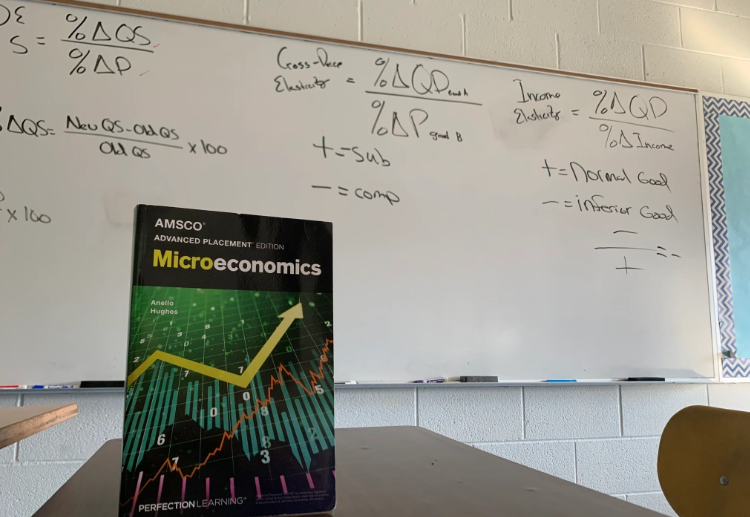
The problem, however, with implementing AP Macroeconomics as a semester-long course is that it forces AP Micro to split in half. According to Mr. Vinluan, head of the Social Sciences Department at Payton, having AP Macro and AP Micro in the same year prohibits students and teachers from diving deeper into the content for either course, and it ends up feeling rushed. Instead, the department decided to “teach a Microeconomics course that focused on depth over breadth. The goal was to develop a class that allowed teachers and students to dive deeper into and apply principles of economics to real-world situations.”
Last year, seven students signed up to take the AP Macroeconomics test in May, self-studying throughout the year. The increasing popularity of this course provides ample reason to implement this course in Payton’s curriculum.
Another gap in the Payton curriculum is the absence of a philosophy or ethics course. To complement advanced math and science classes, Payton students need a space where they can think critically and learn to examine their lives. A philosophy course, which could entail reading philosophical literature, discussing philosophical questions, and generally exploring various ideas and concepts, would allow students to broaden their perspectives and enhance their critical thinking.
Especially in the turbulence of our current social climate, dominated by polarization and echo chambers, critical thinking and exposure to a variety of opinions are crucial skills for our youth to develop. The Society of Philosophers in America argues that in order to combat polarization, educational discourse and constructive conversation are required. Both of these elements are foundational to any type of Philosophy course and will be present in Payton’s curriculum if a Philosophy course is added.
It has been nearly a decade since Payton’s curriculum has included a course similar to philosophy: World Literature: Sacred Text and Philosophy was an English course offered to seniors. In this class, taught by Mr. Wasielewski and Ms. Batiste, students would spend the first semester examining and analyzing various sacred texts and mythology from a literary standpoint. In the second semester, students would study various types of philosophy. They would primarily focus on existentialism, but also ethics and other facets of philosophy.
“Because it was a senior level class, we would approach it through this lens of ‘ok here’s your senior year, this is the end of your high school career. As you matriculate into college and beyond, how can you examine your life at this moment, right now.’ We would approach that examination through these philosophical lenses of existentialism or absurdism. It was a pretty unique class in that regard, because it was personal. There was this application of the content that was very personal” says Mr. Waz.
Although the course was exciting and valuable to students, it was tabled for good reason. Around 8 years ago, the English department was looking to expand its course offerings in a culturally responsive way. World Literature: Sacred Text and Philosophy as well as British Literature had to be discontinued to make room for Payton’s identity literature courses.
As with Macroeconomics, there has been increasing interest in philosophical discourse at Payton. Payton’s Junior Philosophy Club, founded last year, hosts bi-weekly meetings where they host discussions, presentations, and debates about various philosophers and schools of philosophy. This club has gathered more than 20 consistent participants, all demonstrating profound interest in the club and its philosophical discussions.
Senior Charlie Niewiarowski explains, “I go to Philosophy Club every Friday and I learn things that I wish I could explore in a full class day in and day out.”
There have been a multitude of classes added to Payton’s curriculum recently, including AP African American Studies and Honors Film and Literature. However, the absence of AP Macroeconomics and a specialized philosophy course at Payton denotes a significant gap in an otherwise comprehensive curriculum. If the concern is a lack of interest, the initiative shown by students to explore these fields demonstrates the success these classes would have. Implementing these courses would not only fulfill the intellectual curiosities of the student body but would also enhance the diverse learning landscape that Payton prides itself on.

![[Photo Gallery] Homecoming Football Game Payton vs. Brooks](https://paytonpawprint.com/wp-content/uploads/2026/03/img_4761.jpeg?w=1024)
 The Paw Print
Leave a comment