
By Bridget Galibois
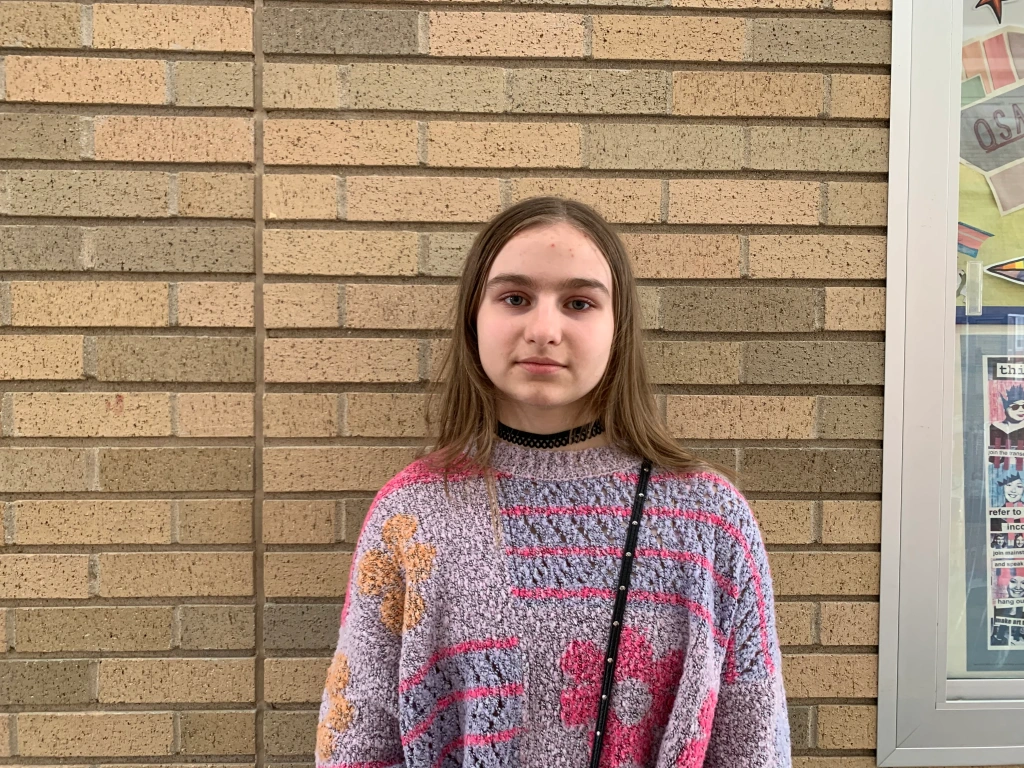
Payton student Ivanna Dzhadzha ‘26 has a lot on her mind: art, sports tryouts, learning languages, and homework to name a few. But amidst the stress of high school, Dzhadzha has been adjusting to life in America, separate from her homeland.
Dzhadzha and her family are Ukrainian; she was born in Kyiv and lived in the city for the first twelve years of her life with her younger sister. They both relocated to Chicago about three years ago, to meet their father who had been living in the United States for about eight years. “My dad was very aware of what was going on between Ukraine and Russia, and he knew that the war could start. A major reason why he wanted to take me and my sister here is so we could have more possibilities in the future,” Dzhadzha said. She cited both education and safety as key reasons why her father wanted her and her sister to come to the United States.
Payton is her fourth school in four years. As part of the pandemic generation, she completed grade school online during the pandemic while in Ukraine, finishing in April 2021— less than a year before the Russian invasion in February 2022. Upon her move to the United States, she completed eighth grade at an American middle school and finished her freshman year at a neighborhood high school before transferring to Payton. “I wanted to go to Payton [for] high school because it was number one, it was just a good school,” she said.
While physically removed from the current conflict, its impacts still reverberate onto her family. Aside from her mother, aunt, and uncle who are living in New Jersey, the rest of her relatives are living in Ukraine. Many of them still reside in Kyiv, and some of Dzhadzha’s uncles are fighting in the war— one of whom graduated from the British Academy and received training on how to use new weapons. She believes they are “pretty much safe… [but] it’s a little bit not safe, where they work and where they live.” If tensions in the city were to escalate at any point, they are ready to relocate to another home in a nearby town.
Thousands of miles away, Dzhadzha has learned how to live in a different, American culture. When learning English in the United States, she found the grammar structure confusing— and the Midwestern accent many around her spoke with didn’t help, either. Now in her third year of school in America, she is expanding her vocabulary and growing more confident when speaking, partially due to her previous multilingualism. Dzhadzha speaks Ukrainian and Russian natively, knows some Polish from her childhood in Kyiv, has studied French and a bit of Spanish in the United States, and is taking up Japanese on her own. In addition to this slate, she is contemplating taking Mandarin classes next year.
At Payton, Dzhadzha has taken advantage of the many academic and extracurricular activities the school has to offer, from languages and art to science and sports. “My major interests are in chemistry and biology… next year I’m going to try taking AP Bio, AP Art, and Comp Sci,” she said. In the future, she is considering a career in science, but is still exploring her other interests and hobbies.
Outside of the classroom, she is a passionate artist. “I used to paint; I have sculpture now. I used to go to an after-school course in Ukraine, where we learned about different artists and tried to mimic their type of art,” she recalled. “Digitally, I also like to draw.”
Presently, she is considering trying out for the Payton soccer team, as she enjoyed playing when she was in Ukraine. She also plans on trying out for the robotics team again next year and is hoping to make the cut.
Many students know about her Ukrainian identity, but she didn’t appreciate it when a classmate only asked her about Ukraine— which she described as “incredibly constant.” Instead, she is glad to have respectful friends that are “interested in learning about my experience.”
![[Photo Gallery] Homecoming Football Game Payton vs. Brooks](https://paytonpawprint.com/wp-content/uploads/2026/03/img_4761.jpeg?w=1024)
 The Paw Print
Leave a comment