

By Steven Jiang, Associate Opinions Editor
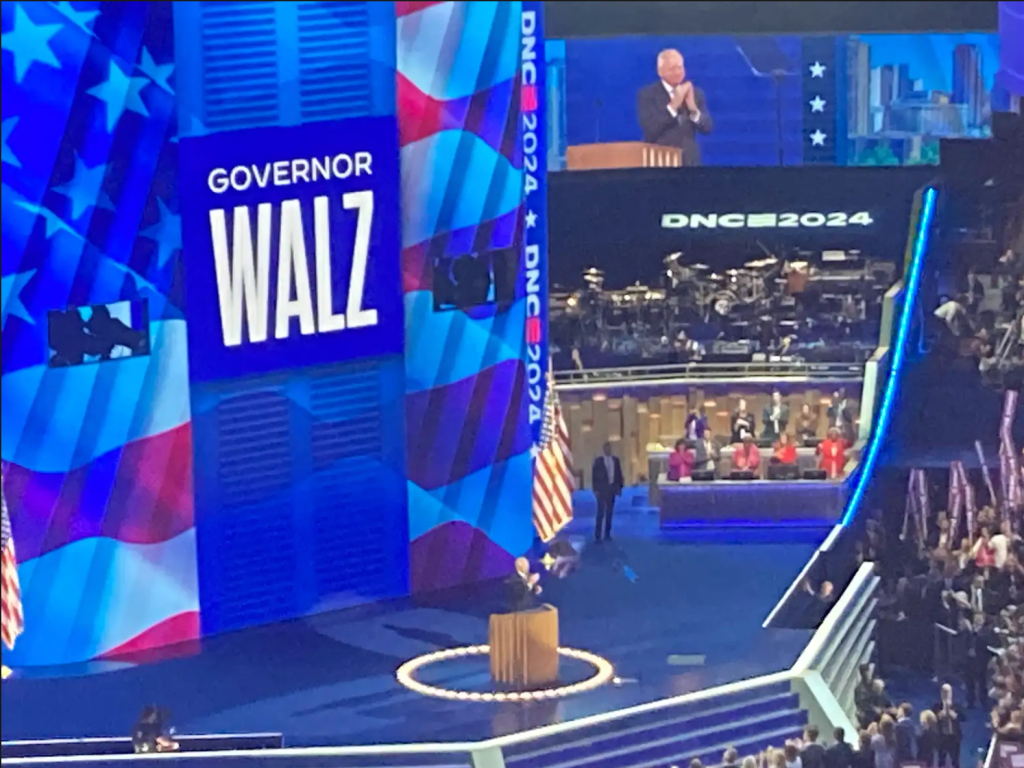
“Tim Walz is the proud product of a middle class family in rural Nebraska…the kind of person who makes people feel like they belong and then inspires them to dream big,” declared Kamala Harris when selecting the Minnesota Governor as her running mate.
With the DNC officially underway in Chicago, Democrats are determined to promulgate their definition of Midwestern values and pitch Gov. Walz as the true voice of the region.
Although vice presidential selections have relatively little influence on election outcomes, they usually convey a symbolic message to America. Trump chose Ohio senator JD Vance to strategically appeal to blue-collar Midwesterners, and Walz’s selection similarly shows how Democrats are pandering to the Midwest.
But despite both candidates proudly displaying their Midwestern roots, the two embarked on opposite trajectories and developed vastly different worldviews. The opposing visions presented by Vance and Walz are a microcosm of a much bigger picture, one that can fundamentally change the dynamics of this election.
A tale of two Midwesterners
JD Vance rose to fame through his bestselling memoir Hillbilly Elegy, which detailed his experience growing up impoverished in Appalachia. Hillbilly Elegy significantly raised Vance’s national profile as a conservative voice for the “forgotten” white working-class families of the Midwest. The book was heavily cited by experts to explain Donald Trump’s 2016 Electoral College victory, in which he carried the critical Midwestern states of Wisconsin and Michigan.
Tim Walz was born and raised in small-town Nebraska. Prior to entering politics, he served in the Army National Guard and later as a high school teacher and football coach, and later served in the House of Representatives representing Minnesota’s first district. According to his government page, as governor he advocated for progressive policies including strengthening worker protections, free school lunches, and capping prescription drug costs.
Minnesota Lieutenant Gov. Peggy Flanagan described her boss as having a “big heart, buffalo plaid jacket, and snacks.” Legendary basketball coach Steve Kerr praised him for his humble community service as a high school coach and teacher. These characterizations further fueled Walz’s persona as a “Midwestern dad” with a tough but kind personality.
Walz’s personality drew a sharp contrast to Vance’s reputation for brash outspokenness, not unlike his running mate. Vance drew criticism for attacking “childless cat ladies” in the Democratic Party and for questioning Gov. Walz’s military service as a fellow veteran.
Hollowed-out cities and forgotten people
To truly grasp the dynamics of Vance and Walz, it’s important to understand the complicated history of the Midwest and the decline of the Rust Belt.
Beginning in the latter half of the twentieth century, American manufacturing declined as a result of deindustrialization and increased outsourcing of labor. Traditional industries like coal, steel, and car manufacturing, which had once fueled the Midwestern economy, suffered greatly. As factories closed and workers lost their jobs, many communities found themselves hopelessly isolated from sources of opportunity. Vance credits his tumultuous childhood in this environment for shaping his social and political views. Over the years, the loss of jobs in the Rust Belt has become one of Trump’s favorite talking points. It puts a more human face on his broader isolationist views on the economy and foreign policy while cementing his unique brand of populism. In 2016, his message stretched into the social, economic, and political realms as voters channeled decades of resentment into a desire for radical change.
Presenting a different vision for change
DNC volunteer Daniel Schack, who grew up in Chicago and attended the Medill School of Journalism at Northwestern University, acknowledged Senator Vance’s tough upbringing but believed that he “grew up and turned his back on the Midwest, claiming in Hillbilly Elegy that it was all their [own] fault.” By contrast, Schack stated that true Midwestern values meant “helping each other” and not denigrating fellow Americans. This sentiment was echoed by Mayor Brandon Johnson, who enthusiastically lauded Chicago as a city of “hard work and caring people.”
Many Midwesterners, Schack observed, felt “left behind in the economy” and that the “culture was changing in ways that they’re not ready for,” creating a sense of alienation. But he believes that the Democrats can reframe their messaging to increase their political capital among this demographic. In particular, branding the Democrats the new party of freedom could counter the conservative trend. “We’re now the party of government staying out of your life, the party of being excited about what brings us together…not a vision of what used to be great for certain people in the past,” he asserted.
Indeed, Democrats spent a significant portion of the opening night trying to change that narrative. Through electrifying speeches and Jumbotron ads, they contrasted Trump and Biden’s impacts in Rust Belt communities and presented a vision for the future.
Union leaders prominently featured in the lineup to praise Harris and Walz as the pro-worker ticket. United Auto Workers President Shawn Fain caused an internet stir by calling Trump a “scab,” referring to workers that refuse to join strikes. Trump had previously applauded Elon Musk for firing workers on strike, which is illegal under federal law.
From 2016 to today, Democrats have realized that Trump is no longer the political outsider without a policy record to compare. Many speakers lauded the Biden administration for leading the nation’s recovery from Trump’s alleged mishandling of COVID-19. Illinois Senator Dick Durbin declared, “Today, more roads are being fixed, more factories are being built, more Americans are working in construction, and more auto workers are making cars than…when Trump was President.” Several videos on-screen emphasized the net job loss under the Trump administration and the rapid growth of manufacturing jobs under Biden. However, these numbers lacked context by downplaying the role of the pandemic in creating mass unemployment in the final year of Trump’s term.
In addition, speakers attacked the GOP’s Wall Street connections and tax cuts for the wealthy, making them out of touch with everyday Americans. “Trump is all talk, but Kamala Harris walks the walk,” declared Fain. The message was clear: Trump was not an anti-establishment champion of the working class; he was the establishment itself.
His running mate? Representative Jamie Raskin (D-MD) called Senator Vance a “pet chameleon” in preaching to the choir for his own political gain.
Looking forward, Democrats promoted an optimistic future of economic growth and workers’ rights. “These investments mean hope…for the places that are too often left behind,” said Durbin. “[Harris and Walz] will fight to bring back American manufacturing.”
The vice presidential debate between Vance and Walz is set to air on CBS News on Oct. 1. It will be a clash of moving life experiences and cultural differences that underscores the diversity of the region. Walz and the Democrats will hope to build off of the momentum from the DNC and paint his unique Midwestern story as an inspiring message to America.
![[Photo Gallery] Homecoming Football Game Payton vs. Brooks](https://paytonpawprint.com/wp-content/uploads/2026/03/img_4761.jpeg?w=1024)
 The Paw Print
Leave a comment