
By Madeleine Spanbauer, Editor-in-Chief
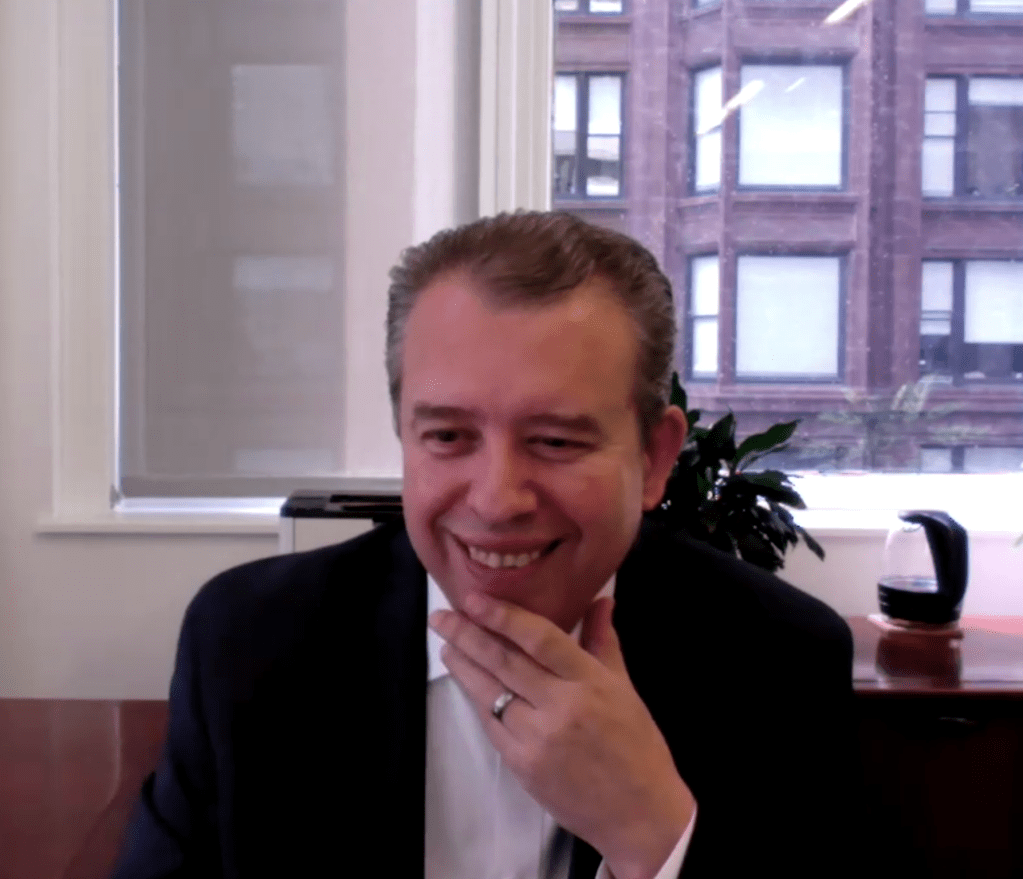
In an exclusive interview with CPS student journalists, CPS CEO Pedro Martinez said that he plans to keep selective enrollment open and available per his five-year plan for the CPS budget. While keeping these schools open, he plans to put more resources and energy into neighborhood schools to strengthen the programs and promote equity throughout Chicago Public Schools.
Martinez was born in Aguascalientes, Mexico, and immigrated to Chicago at age six. He attended high school at Benito Juarez Community Academy, although he was admitted to Whitney Young but wasn’t able to attend due to its distance from his home. “Selective enrollment has been around since I was a student. I had the chance to go to Whitney Young,” said Martinez. “I would have been up at 5 a.m. for a 7 a.m. class and it would be dark because there was no way my parents could drive me.”
Martinez’s five-year plan to fight inequity across CPS schools was approved in mid-September and aims to invest money into existing programs to improve education for all students. Additionally, equitable resources will be allocated to all schools to ensure that students have a quality learning experience. The plan also hopes to build community by partnering with different schools to advocate for equitable school funding.
But what does this mean for selective enrollment? According to Martinez, the city has enough funds to give resources to underfunded schools while still allowing selective enrollment to continue as it has.
“I think we’re big enough and there’s enough wealth in the city and the state that we can be protecting our selective enrollment schools and investing more in our neighborhood schools. And what we’re seeing right now, the reason we’re seeing record scholarships, is because our neighborhood schools are really, really now just operating so strong.”
Martinez wanted to make it clear that he completely supports selective enrollment because it gives students unique educational opportunities. His plan to put more money into neighborhood schools is to build them up, not to bring down the already strong programs at selective enrollment schools.
“I’ve always been a supporter of our selective enrollment schools, as well as our magnet schools because I do believe that they give us some interesting opportunities to learn about what good school models can look like. They’ve always been the first to have Advanced Placement classes and international Baccalaureate programs, but what’s different today is we are investing quite a bit in our neighborhood schools.”
While there are certainly improvements that could be made to improve equity between neighborhood and selective enrollment schools, Martinez said that the city has already made great strides to improve the quality of education in neighborhood schools. “[In neighborhood schools] you’ve seen, even before me, an expansion of Advanced Placement programs, an expansion of International Baccalaureate programs. We have one of the largest International Baccalaureate programs in the country.”
In reference to bringing up the quality of education at neighborhood schools to the same level as selective enrollment, Martinez said, “My goal is, you can still have wonderful programs at Whitney Young and Hancock and all of our selective enrollment schools, but it doesn’t mean that we can’t have strong programs at [neighborhood schools]. It doesn’t mean that we can’t have strong programs at Kenwood.”
Adding to his point about balancing the quality of education across CPS, Martinez said, “We have more students than ever taking AP classes. We have more students than ever in IB programs. So nothing is working backward, it’s all moving forward. Think of it as our selective enrollment has always been strong. They’ve never gotten weak, even during the pandemic, they were still strong and everybody else is now catching up.”
With his new five-year plan, Martinez hopes to support students and parents alike in the complicated process of deciding where to go to high school. He said he has already worked to make the process less stressful for families and understands as a father himself that going to high school can be a difficult thing to navigate.
“We’ve already done some things [to reduce stress for families]. We reduced the testing time because I was worried about a student with a disability. So now the high school exam is shorter and in multiple languages because I was worried about equity for English learners.”
Additionally, Martinez wanted to stress the importance of feeling at home at your school, and said he wants to ask new students, “How do you feel? Do you feel like you’re going to find community here, do you feel something that’s attractive to you?”
In recent news, Martinez and Mayor Brandon Johnson have engaged in a public feud regarding their differing plans for the city. Johnson proposed taking out short-term, high-interest loans and Martinez disagreed with this approach. Johnson allegedly called for Martinez’s resignation and said that CPS needed a leader without specifically mentioning him. The entire Chicago Board of Education announced their resignation on Oct. 4, leaving several things uncertain in CPS’s future.


![[Photo Gallery] Homecoming Football Game Payton vs. Brooks](https://paytonpawprint.com/wp-content/uploads/2026/03/img_4761.jpeg?w=1024)
 The Paw Print
Leave a comment