
By Rehan Mathew Koshy
Tucked away from most of downtown Chicago lies a historic landmark that has captivated visitors for almost a century. Located in the heart of our city’s diverse Bridgeport neighborhood is the newly renovated and reopened Ramova Theatre, which can host around 1,800 guests and is a cultural and architectural gem whose story needs to be told.
Located at 3520 S Halsted St., the theater was designed by architect Myer O. Nathan and was constructed in 1929 by Lithuanian businessman Jokūbas Maskoliūnas. The goal of the “atmospheric” theater was to make the audience believe they were in an elegant European city, as evidenced by its prominent Spanish architecture. A balcony was built to resemble a Spanish courtyard, and the intricate designs and ornamentation on the interior complemented its terra cotta pilasters. The name “Ramova” came from the Lithuanian word for “serene place,” and the theater became the largest in Bridgeport as well as a sister theater to the Music Box Theatre in Lakeview. If this wasn’t enough to attract potential audiences, a giant neon sign with the theater’s name was put up that flashes bright orange at night.
The theatre instantly became a hit and attracted many visitors from around the neighborhood. The complex’s commercial block also contained the Ramova Grill, which drew customers like moths to a flame. Five years later, the theater complex was reported to consist of seven storefronts and was filled with apartments on the second floor. Overall, the theater was a huge success and had continued to exhibit la crème de la crème in terms of motion pictures that were available at the time.
The theater continued to display first run-films until the 1950s which marked the beginning of its downward spiral. Until 1958, the Ramova stuck to its policy of only showing “Class A” films, ensuring that “Bridgeporters will be able to see the best pictures available.” However, the widespread use of television greatly reduced the need for neighborhood theaters and cinemas, so the theater resorted to displaying second-run films.
The Ramova Theatre continued displaying these films for almost thirty years, and towards the end the films displayed were in Spanish, as the demographics of Bridgeport had shifted from primarily Lithuanian and Irish to almost completely Hispanic. Finally, as ticket sales declined, the Ramova Theatre closed its doors after a final screening of “Police Academy 2” in 1985. They remained shut for almost 40 years.
However, the story isn’t over. In 2001, the City of Chicago bought the theater in order to preserve its historic value. 16 years later, Bridgeport resident and real estate developer Tyler Nevius purchased the Ramova Theatre and an adjacent lot from the city for a mere dollar with a vision in mind. He and his wife Emily had realized the significance of this historic gem, and wished to restart the Ramova Theatre’s operations. Nonetheless, before they could venture on this huge project, they needed to do a complete renovation of the theater which required immense funding. The total cost of the renovation would eventually top out at $30 million.
After much negotiation, the project was backed by a total of 55 partners and 49 investors, notable investors being Quincy Jones and Chance the Rapper. Nevius hired local architect Dan O’Riley, who runs his own architecture firm in Chicago, to take charge of this massive project (in collaboration with Baum Revision and McHugh Construction).
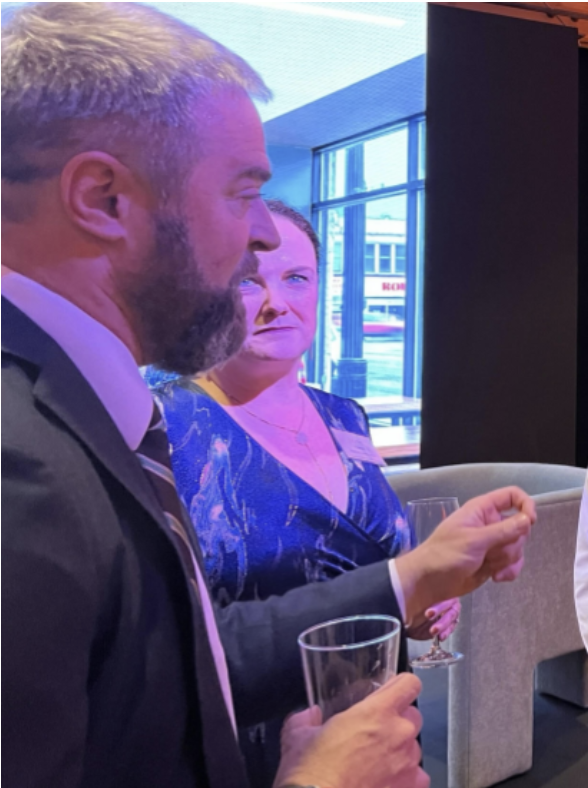
I got the chance to interview architect O’Riley during a gala in the Ramova Theatre. When I asked him whether dealing with complications regarding the theater’s structure was one of the main challenges that he and his team encountered during the renovation, he responded, saying, “That was definitely a challenge.” He said the main issue was that there was lots of work to be done with the dilapidated structure of the building since it shut its doors over 30 years ago. He also mentioned that the city was quite particular when it came to him and his team inspecting each issue regarding the theater’s framework.
After more than two years had passed, the renovation was finally completed. On Dec. 31, 2023, the Ramova Theater, along with the newly restored Ramova Grill, was ready to open its doors to the public once again. With the unique Spanish architecture and interior design preserved, the revamped theater is now more magnificent than ever. Even the neon sign looks brand new, yet it still has that Roaring 20s look from when the theater was first opened.
Being a historic jewel that not many outside of Bridgeport are aware of, the Ramova Theater has been with Bridgeport through thick and thin. Throughout this journey it has not once failed to serve its purpose as a landmark that one can’t miss when it comes to Chicago’s rich and diverse history.

![[Photo Gallery] Homecoming Football Game Payton vs. Brooks](https://paytonpawprint.com/wp-content/uploads/2026/03/img_4761.jpeg?w=1024)
 The Paw Print
Leave a comment