
By Alexa Gola, Associate News & Features Editor
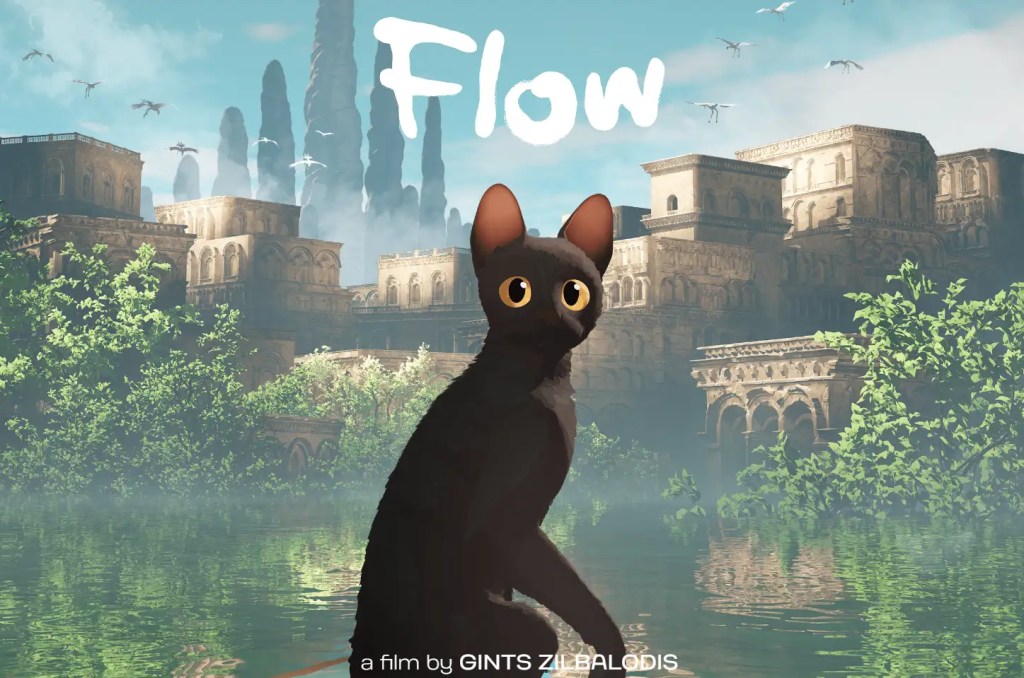
“Straume,” known internationally as “Flow,” is a Latvian animated feature film noted for its absence of narration and dialogue. Directed by Gints Zilbalodis, the 85-minute film premiered at the 2024 Cannes Film Festival, playing at several additional film festivals and in theatres throughout Latvia and France before being released in the U.S. on Dec. 6. The film has won numerous awards, notably including Best Animated Feature Film at the 2025 Golden Globes.
When I first sat down to see “Straume,” I was expecting something along the lines of Pixar’s “Wall-E,” a charming animated film that follows the story of a lonely robot who falls in love, sending him on an adventure across the galaxy. The two films share a lack of words and initially shy, lovable protagonists, but the similarities end there. Where “Wall-E” markets to a younger audience, “Straume” arguably seeks out an older, more artistically invested one. Where the former depicts a human-centric world, the latter includes no humans, and where one explicitly tells its story, making the animator’s creative intentions clear to viewers, the other relies on viewers’ imaginations to piece together meaning from what initially appears to be a vague story.
“Straume” opens with a scene introducing the protagonist, an unnamed cat who appears to prefer to avoid interacting with other animals. The cat shies away from engaging with a passing group of dogs, but takes advantage of their momentary disagreement to take their fish and run away with it. One of the dogs follows the cat back to a place filled with sculptures of other cats, though it’s never explicitly stated how these sculptures came to be. Perhaps they were created by a human who left the protagonist behind, or perhaps they were, at one point, cats themselves?
Whatever the case, the cat is forced to leave this place behind when a flood sweeps the area, leaving them to scramble to higher ground and eventually, a boat. There, they have little space available and thus little choice but to interact with other animals, if reluctantly at first. The cat, the dog, a capybara, a lemur and a secretarybird find themselves living together for the foreseeable future, and with time, they appear to care for each other. The secretarybird protects the cat from other members of its flock, despite being left behind for doing so. The cat, who was once afraid of water, collects and shares fish with their newfound friends.
It is never the film’s plot, but instead the often subtle shifts in the animals’ behavior that make “Straume” so captivating. When the cat chooses to collect and later share food with the other animals, we might see the action as extending a hand of friendship to those the cat has grown closer to throughout their voyage. Then again, we might also see it as a grudging acceptance of responsibility for the crew’s collective wellbeing. In either case, there’s something very implicitly human in the way the film’s characters act. Despite including no dialogue, “Straume” allows us to see ourselves and others in its characters, who seem to communicate their intentions in a way unique to each member of the audience.
“Straume,” in many ways, becomes what we as viewers want it to be. It could amount to an extended version of a charming short film following the adventure of a cat, or it could become an exploration of human nature through the dynamics of its characters. The film is certainly about a cat, but on another level, it’s also about discovering what we see and value in interactions between ourselves and other beings. Above all, “Straume” appears to be a celebration of the shared creativity between its artists and audience, and for that, I think it effectively captures the heart of what animation is meant to be.

![[Photo Gallery] Homecoming Football Game Payton vs. Brooks](https://paytonpawprint.com/wp-content/uploads/2026/03/img_4761.jpeg?w=1024)
 The Paw Print
Leave a comment