
By Kieran Blake, Sports Editor
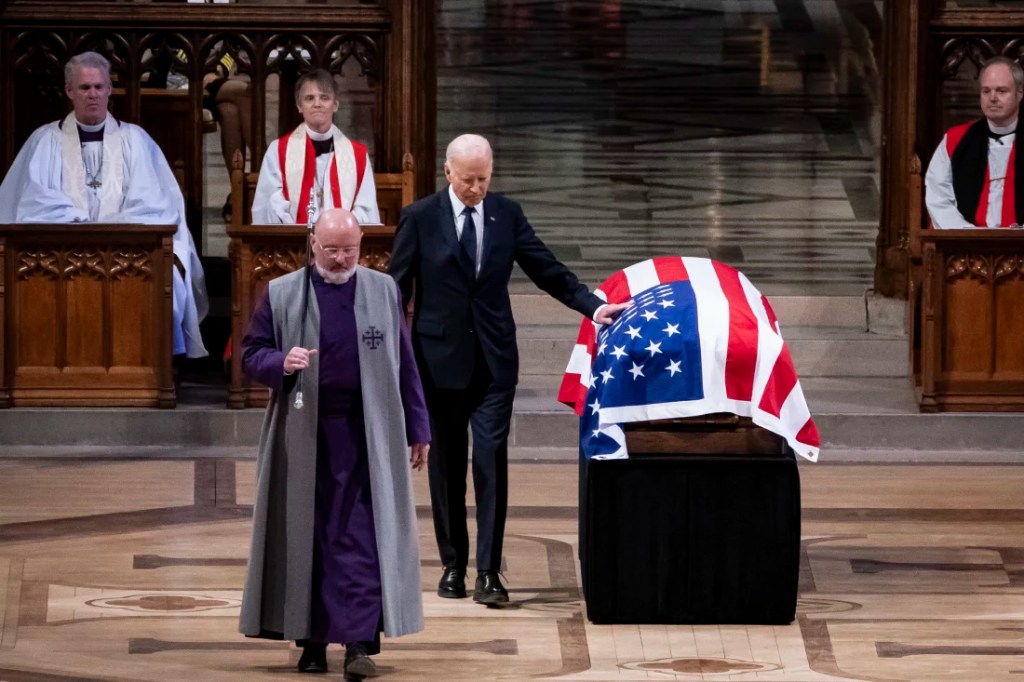
As I sat in my grandparents’ basement enjoying my winter break, I looked down at my phone and saw a notification from Apple News. Jimmy Carter, who had become the first ever centenarian former president in United States history two months earlier, had passed away. News coverage in the ensuing days focused almost exclusively on his passing, and tributes came pouring in from across the world. In honor of the former President, I decided to examine his complex legacy both in the field of politics and out.
James Earl Carter was born on Oct. 1, 1924 to a lower-class farming family in Plains, Ga. As he grew older, he helped his family get by working as a peanut farmer before attending the Naval Academy, where he met Rosalynn Smith, his wife of 77 years who died in 2023. Carter served active duty in the Navy from 1946 to 1953. He then continued to help his family’s peanut-farming business. During this time, Carter began to speak out in favor of the civil rights movement. He also became a prominent figure in his Baptist Church community.
In 1962, Carter was elected to the Georgia State Senate, and he began his term the following year. In the segregated South of the 1960s, Carter spoke in favor of integration and against racism. Following his second term, he entered the 1966 Georgia gubernatorial race, but he lost the Democratic nomination to Lester Maddox, who went on to win a contested election against Republican Rep. Bo Callaway. During the 1970 gubernatorial election, Carter ran on a populist platform and defeated former Gov. Carl Sanders for the Democratic nomination before easily winning the general election. Despite his earlier support for racial tolerance, he leaned in heavily on racism more in order to clinch the nomination.
During his governorship, Carter immediately came out against racism and fought for civil rights, angering many of his constituents. He also fought against busing and for the death penalty, and he attempted to bring his name to national attention later in his term, with mixed results. He was named chairman of the Democratic Party’s gubernatorial and congressional campaigns before his term expired in 1975.
When it came time for the 1976 Democratic primaries, Carter had a relatively low national profile. Despite this, Carter eventually emerged as the frontrunner by positioning himself as an outsider with integrity in the wake of the Watergate scandal. After easily clinching the nomination, Carter and his running mate, Minnesota Sen. Walter Mondale, defeated incumbent President Gerald Ford in the general election. The small town peanut farmer from a lower-class family had risen to the most powerful position in the country.
Carter’s time in office was marred by economic downturn and stagflation, an energy crisis and most notably, the Iran hostage crisis. Carter inherited the poor economy of the 1970s from Richard Nixon and Ford, and his attempts to alleviate this economic recession were ineffective. On top of this, the 1979 Iranian revolution led to a decrease in oil production that had a drastic effect on the price of oil in the U.S. While he did reduce unemployment significantly, his economic policies were still frowned upon by many Americans.
Perhaps the most significant event of Carter’s presidency was the Iran hostage crisis. In late 1979, following the Iranian revolution, a group of armed Iranians stormed the U.S. embassy and took over 50 Americans hostage. Ayatollah Ruhollah Khomeini, the Iranian leader, demanded that the U.S. give them the exiled Shah Mohammad Reza Pahlavi, who was in the U.S. undergoing cancer treatment. Carter retorted by placing Iran under embargo and freezing Iran’s U.S. bank accounts. Carter then authorized the disastrous Operation Eagle Claw, during which eight U.S. soldiers died in a botched rescue attempt. Carter’s popularity was sinking, and when election day rolled around in 1980, he was defeated in a landslide by former California Gov. Ronald Reagan. It didn’t help Carter that his challenger in the primaries, Massachusetts Sen. Ted Kennedy, had refused to endorse him.
While economic troubles and the Iran hostage crisis are likely the defining elements of Carter’s presidency, that isn’t to say he didn’t have some accomplishments. Most notably, he brokered the Camp David Accords between President Anwar Sadat of Egypt and Prime Minister Menachem Begin of Israel, ending decades of war between the two countries. He also established the Department of Education, signed the SALT II treaty to reduce nuclear armaments and led a boycott of the 1980 Moscow Olympics over their invasion of Afghanistan that was joined by dozens of other countries across the world.
Carter remained a tireless fighter for human rights throughout his presidency, and he attempted to improve relations between the U.S. and its Cold War enemies, just as Nixon had a few years earlier. Some of his other actions that were met with mixed results were his pardoning of Vietnam War draft dodgers and his returning of the Panama Canal to the Panamanian government. On top of that, he was an honest man with a moral compass. While he may not have been a superb president, he certainly was an admirable human being.
Perhaps there is no better proof of this than his actions after his presidency. He remained engaged in diplomacy across the globe, and he rarely ever shied away from criticizing or praising the actions of his successors, regardless of their political affiliation. He remained a prominent figure in the Democratic Party over the next few decades, and he remained vigilant in his fight against social injustice and inequality. He founded the Carter Center, an institution dedicated to fighting for human rights worldwide. He founded the New Baptists Covenant in order to fight for social justice. He faced controversy for criticizing Israel over what he called “apartheid” in the West Bank and Gaza Strip, but he remained vigilant in attempting to raise awareness in the U.S. for Palestinian rights and peace in the Middle East. He led the charge against human rights violations and diseases across the world for decades.
Jimmy Carter remained a humble man throughout his life and political career. He continued to stand up for the rights of the disadvantaged and oppressed even after leaving office. The field of politics is often morally hazy, but Carter remained a man guided by his moral convictions. He dedicated his life to helping others; he was still building homes into his 90s as one of the most dedicated members of the affordable housing organization Habitat for Humanity. He was restless in his commitment to advancing the quality of life of all those around him, and those values seem to have all but disappeared in politics today.
Carter was the living embodiment of the American Dream. He started from humble beginnings as a poor farmer. He bravely served his country in the military. He started a family and helped his community. He entered politics and rose through the ranks to the presidency. After he was defeated, he returned back to his roots– right where it all began on a peanut farm in Plains, Ga., where he continued to fight for others. Jimmy Carter is the embodiment of a true Christian. He lived life by one rule: “Love thy neighbor.” Jimmy Carter may not have been a great president. But he was, without question, a good man.


![[Photo Gallery] Homecoming Football Game Payton vs. Brooks](https://paytonpawprint.com/wp-content/uploads/2026/03/img_4761.jpeg?w=1024)

 The Paw Print
Leave a comment