
By Addison Davis, Staff Writer
The age of streaming has, in a lot of ways, made our lives more accessible. You can now listen to nearly any song, watch nearly any movie or show, or read nearly any book with just your phone. And in a lot of ways, spending a few hundred dollars on a tiny device that can do all that and more is completely worth it. I love the fact I can google anything whenever I want and watch movies on a flight and listen to whatever song I want on a long car ride or on the train. And many people would say the same.
But this accessibility can also make us more distracted. For instance, if I’m working on homework and constantly skipping songs on my phone, I’m more tempted to check my phone for text messages as well. When I put on my vinyl, I find I’m much more productive. Just letting the album spin and the music flow through my ears allows me to set goals for myself, mentally motivating myself, “Once I finish Side A I’ll take a 5 minute break, and once I finish Side B I’ll take a 10 minute break.” There’s just something that allows me to fully focus and lock in, part of that being endless choice being stripped away. You can only listen to vinyl you actually own, and if you want to skip a song or change the album, you have to get up, stop the record, lift the needle, etc, etc. It’s a whole process, and it seems a lot easier to just finish your work and take a mental break once the album finishes.
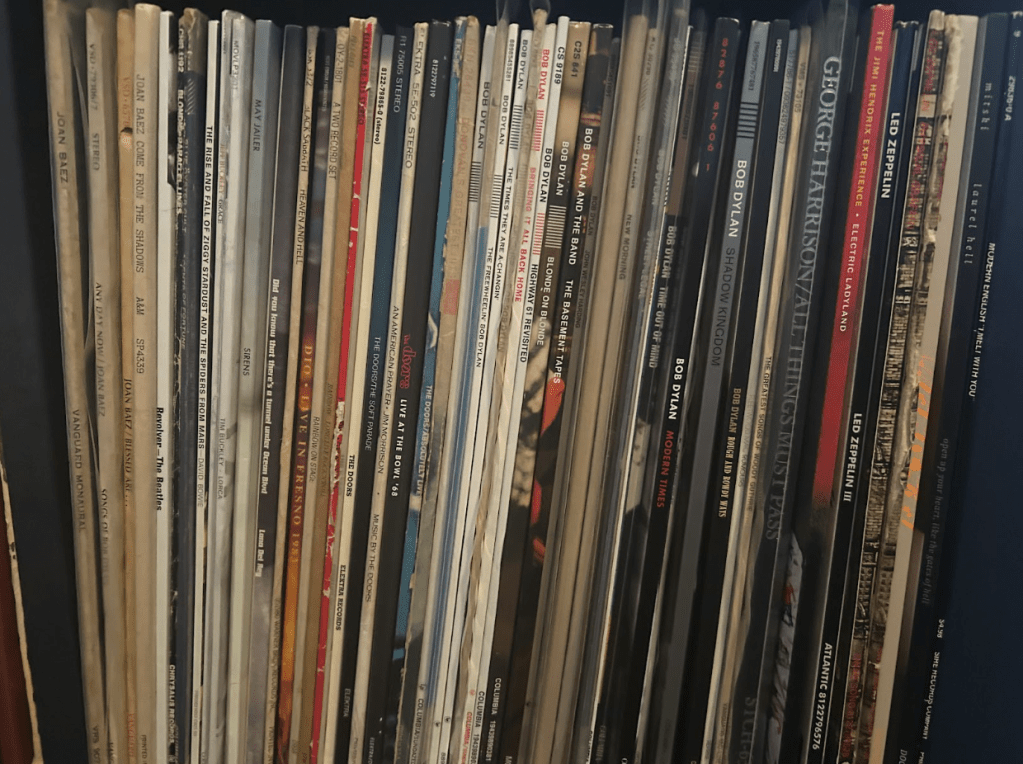
I’m a vinyl collector. I’ve inherited some of my father’s old LPs he saved from 40-50 years ago, but he switched to CDs and never looked back, trading in a majority of his collection for the CD copy. There’s so much I personally love about vinyl, both in comparison to CDs or cassette tapes but also the very fact it is physical media. If you’ve never bought or used a vinyl record before, I just want to describe it to you.
The very act of getting the record is an entire story in it of itself – sometimes you just randomly pop into your local record store, or maybe you take the train for an hour to get to a very specific location to look for a very specific record that you’ve been wanting for ages, or maybe it’s been gifted to you by a friend or family member or acquaintance or teacher or coworker or someone else significant in your life. Maybe it’s passed onto you from a loved one or someone who has passed on themselves and whom you’ve never met. There’s something so personal and special about how you got the record, not even including the music inside. Maybe it’s a record you didn’t expect to get, or maybe it’s one you’ve been wanting for a long time, or maybe you had no idea what to expect when you put the needle on. Some albums I listened to the first time through physical media, and there’s something so precious about that, as if the album has a more significant connection.
Then there’s the feeling of actually unwrapping the vinyl. There’s a number of fun features you can’t get through streaming, and creative album design can add more to a given album. For example, my Led Zeppelin III LP has a pinwheel feature, the cover having holes allowing the owner to spin the background with different photos filling in the holes. I’ve spent a good amount of time just playing around with that feature, let alone listening to the album. It seems recently a lot of modern artists work hard on these album features, some albums coming with extensive booklets or colored vinyl variants. An album is not just the front cover, but the liner notes, the booklet, the back cover, the gatefold.
And having access to those features adds so much more to the album than one would think. I’ve found liner notes a particularly interesting one, adding insight into the album’s production and what the artist thinks of the album. Multiple of my Bob Dylan LPs have unique poems of Dylan’s on the back, adding supplemental material to the album itself. All of this doesn’t even encapsulate the little things you find when buying a used record, songs mysteriously underlined on the tracklist or certain songs being more worn than others. I’ve found there’s always more to discover with these features, and often notice things I hadn’t before.
Lastly, there’s the act of actually placing the needle on the record, the grooves being softly brushed by the pointy player, the sound going through the machine and coming out through the speakers. There’s a certain intimacy to it, listening to something so carefully crafted, be it made a few months ago or 50 years ago. Watching the record spin, you can see each individual sound embedded in the plastic, moving in a circular motion, a spiral of sorts. It’s unexpectedly hypnotizing in a way. As the sound plays, it feels like you’re watching the music being created right in front of your eyes, even if it’s been replayed over and over. Each listen feels like a unique experience because of one’s personal relationship to the records and all the little scratches and marks add to the music, not take away from it. Due to vinyl’s imperfect form it’s likely not much better quality than if I were to put my headphones on and play the album through Spotify. But there’s something so special about delicately putting the needle on the record’s tiny grooves and music somehow, almost mystically, coming out.
Record stores are one of my favorite places to be. The smell of new and old records blended together, the rare (and often expensive) records displayed on the wall, the sound of the music playing from the overhead speakers, the feel of the records slipping through your fingers as you flip through decades worth of music, staring at someone’s haul or patiently waiting to look through a busy section, smiling at fellow consumers who have similar tastes. I feel a connection to the people there, even if I don’t say a word to them. It’s like we’ve made a psychic connection, one not bound by words and movements but by artwork and grooves. Sometimes, though, I strike up a conversation with the cashier or a middle aged man will come up to me, asking, “You know [insert classic rock artist here]? Really?”
Vinyl is most certainly less convenient. For one, you need a record player, which isn’t as common as a phone or laptop. Secondly, you need the money to pay for records, and new records are getting increasingly expensive due to demand and inflation. Third, you can only listen with the record player and the giant record, and virtually can’t transport it out of your house regularly while being careful with the equipment and LPs. And fourth, you have to get up and flip the record each time a side ends, in addition to finding space to set up the player and speakers.
But I’d argue that all these things make vinyl all the more special – it’s dedication and it creates a deeper connection with the music. Saving up so you can buy that one record you’ve been wanting for forever, it all pays off in the end, and you feel like you’re doing something for the artist. Not only does it create a deeper connection with the artist, but with other people. Vinyl collectors make up a community, one that allows all sorts of people to bond with one another over a shared passion – music.
![[Photo Gallery] Homecoming Football Game Payton vs. Brooks](https://paytonpawprint.com/wp-content/uploads/2026/03/img_4761.jpeg?w=1024)
 The Paw Print
Leave a comment