
By Steven Jiang, Associate Opinions Editor
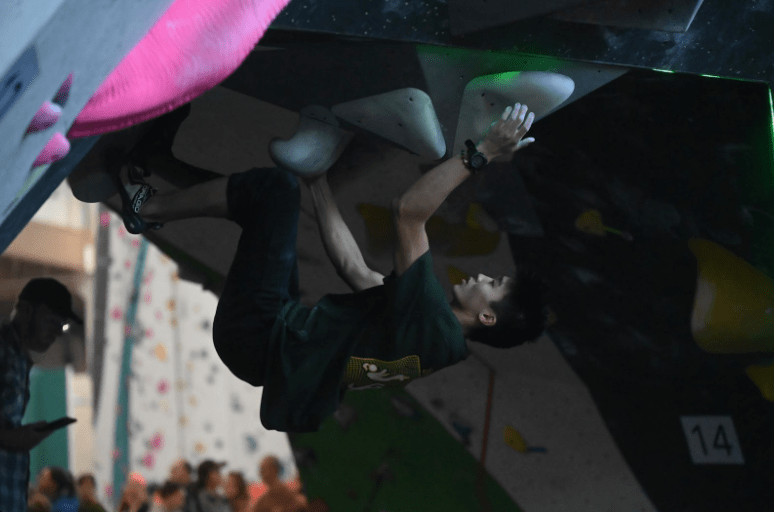
Alex Zhu ‘26 maneuvers on a kilter board at a local climbing competition. Photo by Sarah Kam, courtesy of Alex Zhu.
Payton student Alex Zhu ‘26 is no stranger to intense physical exertion. You can find him at his local gym outside of school hours, artfully scaling walls on seemingly impossible inclines. He’s been bouldering for five years now, with numerous competitions under his belt. Zhu and many other students here at Payton are part of a thriving community of climbing enthusiasts. They’re excelling at a once-niche sport that’s quickly becoming mainstream.
There are three main disciplines within indoor climbing: bouldering, top-rope climbing, and lead climbing. Top-rope and lead climbing are performed on high vertical walls with a safety rope and harness, while bouldering is performed closer to the ground. Zhu specializes in bouldering, which involves climbing up a tilted surface with holds known as a kilter board. LEDs in the kilter board illuminate the pattern of holds that the climber must use. Each board has a technical difficulty rating in the V-scale, which ranges from V0 to V17. “I got a V10, which is fairly hard,” says Zhu. “That’s the highest grade I’ve ever gotten so far.”
Every other day after school, Zhu trains at a local indoor climbing gym for three to four hours. His workouts range from weightlifting to high-intensity intervals of rapid climbing. It’s important to build both raw explosiveness and power endurance. Furthermore, climbing targets virtually all muscle groups, from legs to core to upper body. On the importance of consistency, he emphasizes, “I feel like I’m responsible for getting the hours in and training my body…to push myself and reach higher limits.”
Prior to each climbing session, Zhu puts on tight climbing shoes and applies chalk to his hands, both of which increase grip. He also mentally plans out his route, figuring out the optimal position that his body should be in at each hold. “You have to envision yourself moving your hands and your feet on the holds that you look at,” says Zhu. Having a clear plan of attack prevents needlessly wasting energy, a skill he calls “reading the climb.” When he’s on the wall, Zhu uses his full body to swing upwards from hold to hold. He briefly catches his breath, loosens his muscles, and refocuses after quick bursts of energy. Some holds, known as crimps, are extremely small and strain his fingertips, while others are just beyond his reach. Effective technique is just as important as raw strength, asserts Zhu. Having body awareness and properly engaging the legs often distinguishes advanced climbers from novices.
Given the extreme physicality of bouldering, Zhu emphasizes the importance of safety and injury prevention. He acknowledges that he overcame his fear of heights by getting comfortable with falling, which is a crucial skill. “Fall on your legs let your body absorb the weight,” advises Zhu. “Make sure you don’t fall on your arm.” Tears to the skin are also fairly common as a result of friction against the holds. When that happens, he applies protective tape to his fingers to prevent bleeding. Zhu also ensures that he allows his body to adequately recover from muscle soreness. “A lot of people can be prone to like overtraining, and that’s just going to set you back more.”
Climbing is a very goal-oriented sport, Zhu explains. He’s currently working on conquering the next obstacle: a V12 climb on the kilter board. “Sometimes there’s going to be a climb that may feel impossible at first,” he says, but it’s all about grit and dedication. And the feeling of immense pride when he finally completes the climb makes it all worthwhile.
“Most people that started out climbing usually have the same story: they just walk into the gym and fall in love with the sport,” says Zhu. Although climbing is not an official IHSA sport, the Climbing Club at Payton meets during enrichment periods to scale the wall in the East Gym via lead climbing. All safety equipment is provided and more experienced climbers guide novices through the process. It’s a positive and encouraging atmosphere for everyone to challenge themselves. “Climbing is an inclusive sport,” says Zhu. “It’s nice to climb with your friends, which is more enjoyable and productive.” Regardless of your skill level, climbing is a rewarding experience that everyone should try.


![[Photo Gallery] Homecoming Football Game Payton vs. Brooks](https://paytonpawprint.com/wp-content/uploads/2026/03/img_4761.jpeg?w=1024)
 The Paw Print
Leave a comment