
By Alexa Gola, Associate News & Features Editor

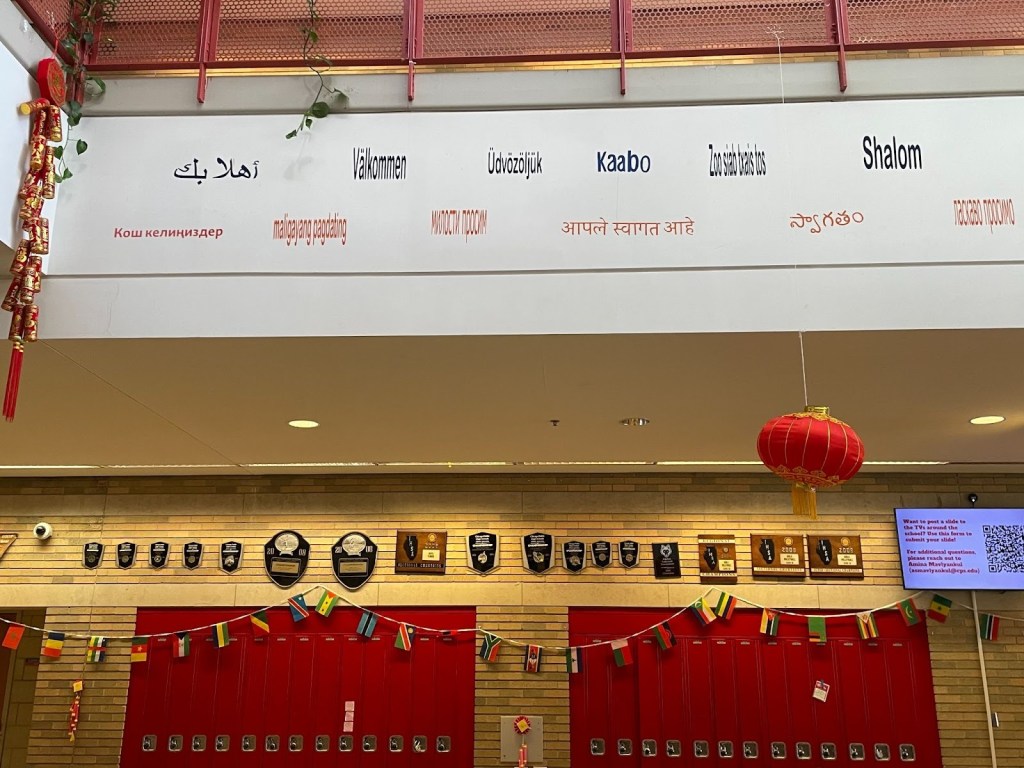
Payton’s student body elected their 2025-26 LSC representatives on Feb. 12. Photo courtesy of Alexa Gola.
After Payton’s Local School Council (LSC) elections were held on Feb. 12, the student body’s 2025-26 representatives were announced: Anden Hong ‘27, Tra’Monti Williams ‘26 and Sonia Rosa Sifore ‘26. The Paw Print interviewed the three new representatives to get to know them and their goals for next school year.
To understand the representatives’ goals, students first need to understand what the LSC does. According to Williams, “LSC covers a lot of the important financial decisions that go on and that really impact us. [They also cover] reports on behavior and how students feel and operate, what’s going on the student side and how we are communicating with each other.”
Though students may primarily interact with the LSC to have their fundraising and financial requests approved, the body also serves a broader purpose.
“I also think it’s a place where some of the most important people in the school are going to be. You have the principal, you have your two teacher representatives who know pretty much everything, all the department [chairs],” Sifore said, pointing to the LSC as a place where important school figures can be found to help the student body.
With those functions in mind, each of the representatives decided to run for the LSC. While Williams and Sifore saw becoming representatives as a chance to specifically ensure that the student voice is listened to, Hong saw it as a broader opportunity to “make a difference in the school” and an extension of his work in student government.
“I know that some people tend to be quiet and tend to be scared to share their opinions, so I just wanted to make sure that I was there to bridge the gap between the people who may be afraid to speak up,” Williams said, adding that he would like to ensure that Payton “continues to become a better place where everyone can thrive” after he graduates.
Sifore said the role appealed to her because it offered the opportunity “to work with somebody who has the power to make a change and [to] make sure that they’re hearing students’ concerns.” She wants “to make sure that they’re also listening, that we’re working together to come up with solutions.”
“As a member of student government, I’m hoping to be that person that helps connect student government and LSC and [to] use my position [on] both student government and LSC to help speed [up] communication,” Hong said. He has represented the Class of 2027 for the past two years and plans to continue his involvement in student government.
As for specific goals, Hong hopes to “increase efficiency with budgeting,” which he believes is one of the most important jobs of the LSC.
Meanwhile, both juniors plan to focus on improving communication surrounding the LSC.
“I really want to make sure that everyone knows what’s going on. As I said before, [the LSC does] go over a lot of big decisions, and [it is] a space to voice any concerns or just comments about the community in general,” said Williams.
“But if a lot of people aren’t aware of the LSC being a thing, then there isn’t a lot of space for commentary. I really want to make sure that LSC gets out to a broader range of people, [including] the student body [and] more community parents, so that we’re able to gain more voices as a collective, to generate more things to build a better Payton.”
Similarly, Sifore plans to focus on “social outreach and the time it takes to get information out to people.”
“I know the meeting minutes can drag a bit, and people are always curious and asking, where are the meeting minutes? You [want to] know what’s going on, and you know those still have to get approved [by the LSC], but if we could work on [the] timing [with] getting those out and getting people informed, I feel like that would definitely help reduce tensions when there is controversy and conflicts.”
Williams and Sifore plan to accomplish these goals by increasing communication surrounding club grants and taking specific, actionable steps to help address student concerns. For example, if students have “social concerns with politics,” Sifore suggested that the LSC can take both large and small steps to ensure “that they feel comfortable at school, safe at school, heard at school,” such as “having certain flags out in the hallway from different countries, where different students may be from.”
Hong also has some ideas to improve communication.
“I noticed that the LSC posts Zoom meetings every time. But I’m hoping to maybe make a letter that’s posted, maybe included [in] the Payton Pulse, that summarizes the meetings after, because sometimes people can’t make those hour meetings, [and it is important to] to become more transparent with the student body and communicate what actually goes on in the LSC.”
To students who are interested in becoming more active and involved in the school community, Williams strongly recommends attending LSC meetings. According to him, doing so offers students the opportunity to give public statements and to receive information directly from its sources. Sifore also encourages students to speak out, ask for help and advocate for themselves, while Hong reminds students that they “can come up to any of us [LSC representatives] and tell us what’s going on.”
Williams, Sifore and Hong can be reached through social media, email and their Google Forms, which they plan to “build off and make more accessible” during their term. Additionally, the representatives invite students to approach them in the halls to offer opinions, concerns and potential solutions.
As Hong said, “We’ll always listen to you. We’ll always be open. You can always make a change no matter what you believe in; you’ll always be able to express yourself.”


![[Photo Gallery] Homecoming Football Game Payton vs. Brooks](https://paytonpawprint.com/wp-content/uploads/2026/03/img_4761.jpeg?w=1024)
 The Paw Print
Leave a comment