
By Kieran Blake, Sports Editor
I have mixed feelings about Ronald Reagan’s presidency. As a liberal, I dislike his tax cuts for the rich. I loathe the way he handled the racially-motivated War on Drugs. To this day, I question his role in the infamous Iran-Contra Affair. But I have to give him credit for one thing: Ronald Reagan helped end the Cold War.
Reagan was vehemently opposed to the Soviet Union. He called them an “evil empire.” He tried to cut off the Soviet Union’s Western European gas line in an effort to cripple their economy. He ramped up defense spending on missiles for potential use against the U.S.S.R. He forced the Soviets to try hopelessly to outspend the U.S., and he helped weaken Soviet dominance in Eastern Europe. He famously declared in a speech outside the Berlin Wall: “Mr. Gorbachev, open these gates. Mr. Gorbachev, tear down this wall.”
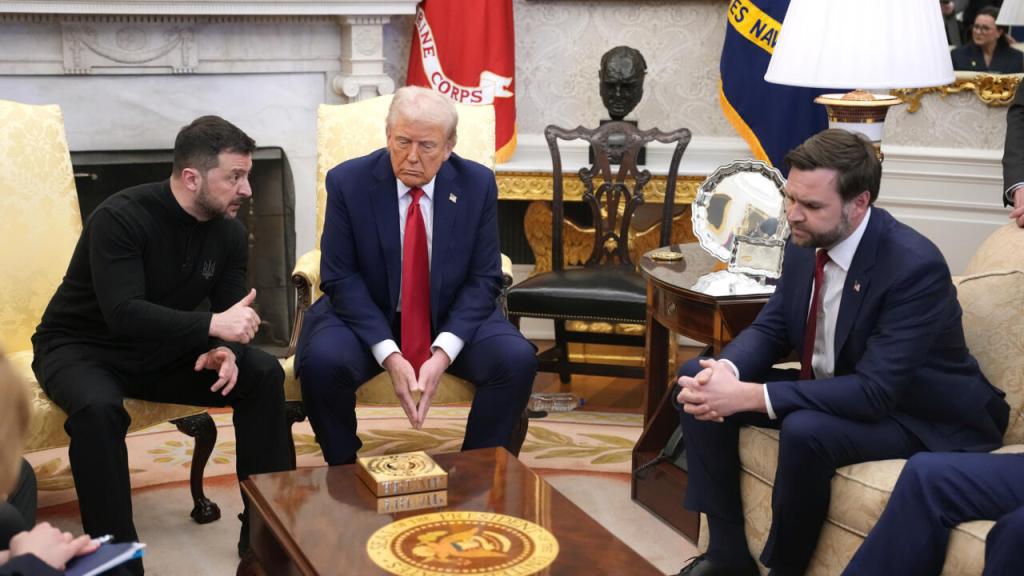
Ronald Reagan is an icon of the Republican Party. Conservatives champion Ronald Reagan as the epitome of the Republican president. They champion his tax cuts for the rich. They champion his social conservatism. They champion his belief in limited government. Republicans love to call themselves the “Party of Reagan.” Well, after Donald Trump’s Oval Office meeting with Volodomyr Zelenskyy, Ronald Reagan must be rolling in his grave.
When the Ukrainian president met with Trump and his cabinet in the Oval Office, he was berated with a barrage of accusations and insults. Zelenskyy was ridiculed by Trump and Vice President JD Vance for not thanking the U.S. for their constant support, despite the fact that the very first thing that Zelenskyy said aside from the words “very proud” and “yeah” was: “Thank you so much, Mr. President.” Not only did Trump and his cronies attack Zelenskyy for his manners, but they also criticized him for not wearing a suit. May I remind you that when Elon Musk stood in that very same room in early February, he wore this.
Aside from the attacks on Zelenskyy’s etiquette, Trump also tried to muscle the Ukrainian leader into a deal for Ukraine’s mineral resources by threatening to withdraw U.S. aid to Ukraine. When the possibility of Vladimir Putin reneging on a ceasefire deal was brought to Trump’s attention, he dismissed by saying, “What if anything? What if a bomb drops on your head right now?” Rather than answering a very pressing question, as Putin has broken countless agreements in the past, Trump answered the question with two hypothetical questions. The war in Ukraine is not “hypothetical.” Ask the families of the over 12,000 dead civilians if the loss of their loved ones was “hypothetical.”
Following the meeting’s implosion, many Republicans in Congress found themselves doing a balancing act of praising Trump and standing by Ukraine. Some criticized the meeting and defended Ukraine, with Alaska Sen. Lisa Murkowski taking an even stronger stance against “walking away from our allies and embracing Putin.” Those who truly defended Ukraine, however, were few and far between. South Carolina Sen. Lindsey Graham, a staunch advocate for Ukraine aid during Joe Biden’s presidency, all but caved in to Trump by calling on Zelenskyy to resign. Trump is not a lone ranger in his apparent abandonment of Ukraine; he has the Republican Party behind.
It has been clear for a while now that Donald Trump has fundamentally altered the Republican Party. Following the Trump-Zelenskyy meeting, however, it became clear just how much he has done so, especially in the realm of foreign policy. Look no further than the rhetoric regarding the Soviet Union, and later, Russia, used by every other Republican nominee for president since the Cold War began in 1947.
In 1948, the Republicans nominated New York Gov. Thomas E. Dewey, who led an early version of the Eastern Establishment– a group of internationalists who wanted to fight the Soviet Union during the Cold War. In 1952 and 1956, the Republicans nominated World War II hero Dwight D. Eisenhower, who used the CIA to surreptitiously overthrow communist governments and decried Soviet actions during the Hungarian Revolution. In 1960, Republican nominee and then-Vice President Richard Nixon ran on a strong anti-communist platform and used hawkish rhetoric when discussing the Soviet Union. In 1964, Arizona Sen. Barry Goldwater was nominated, and he was famously very hawkish and aggressive toward the Soviet Union and communism. In 1968 and 1972, Nixon was again nominated, and though he did foster vastly better relations with Moscow, he still stayed loyal to U.S. allies. In 1976, President Gerald Ford was nominated and infamously said that “there is no Soviet domination of Eastern Europe,” which, although a gaffe, implied a strong hand against the Soviets.
In 1980, Reagan was nominated, and as discussed previously, he despised Soviet communism and Moscow. He basically ended Nixon and Ford’s detente and demonstrated hawkish rhetoric and foreign policy toward the Soviet Union. He won reelection in 1984, continuing to remain strong in his vehemently anti-Soviet foreign policy. In 1988, his successor, Vice President George H.W. Bush was nominated and presided over the fall of the Berlin Wall and the end of the Cold War before being defeated in 1992 by Arkansas Gov. Bill Clinton.
The reestablished Russia was not an issue for Kansas Sen. Bob Dole in 1996, Texas Gov. George W. Bush in 2000 or now-President Bush in 2004, though Bush did express support in 2008 for Ukrainian and Georgian membership in NATO. 2008’s nominee, the late Arizona Sen. John McCain was famously anti-Russia, and he too supported Ukraine and Georgia joining NATO. In 2012, Republican nominee and former Massachusetts Gov. Mitt Romney said in an interview that Russia was “without question, our number one geopolitical foe.”
Since his first term, Donald Trump has praised Vladimir Putin, and he has recently been bringing the U.S. closer to Russia since his inauguration back in January. He has caused great concern among U.S. allies in NATO, and the U.S. recently held peace talks with Russia present and Ukraine not so. The U.S. also joined Russia and North Korea in voting against a United Nations resolution condemning Russia for starting the war in Ukraine. He criticized NATO in his first term, and he recently refused to support American allies in NATO if they “don’t pay” as much as the U.S. has. He has floated the idea of withdrawing from NATO multiple times, and right now, he seems to be coveting a potential alliance with Russia over standing by Ukraine, NATO and the freedoms that America symbolized throughout the Cold War.
If Ronald Reagan were alive today to see what the Republican Party has become, he would vomit. He spent his presidency dedicated to fighting Moscow’s suppression of freedom. We could talk about why he did so all day, but the fact of the matter is that he did. He did not betray our allies in Europe but rather worked with them. He decried the Soviet Union and Premier Mikhail Gorbachev. His foreign policy will forever be a cornerstone of his legacy as president. If he saw the way that Donald Trump praises Putin and turns his back on our allies, he would be disgusted. Ronald Reagan would have been a leading advocate of Ukrainian membership in NATO. He would have committed to supplying them with foreign aid until the Russian threat was eliminated. The Republican Party has stood almost in lockstep behind Trump during his second term. They are now the party of Donald Trump. They are now the party of MAGA. They are far from the party of Ronald Reagan.



![[Photo Gallery] Homecoming Football Game Payton vs. Brooks](https://paytonpawprint.com/wp-content/uploads/2026/03/img_4761.jpeg?w=1024)
 The Paw Print

Leave a comment