
By Elena Whitford, Arts & Culture Editor
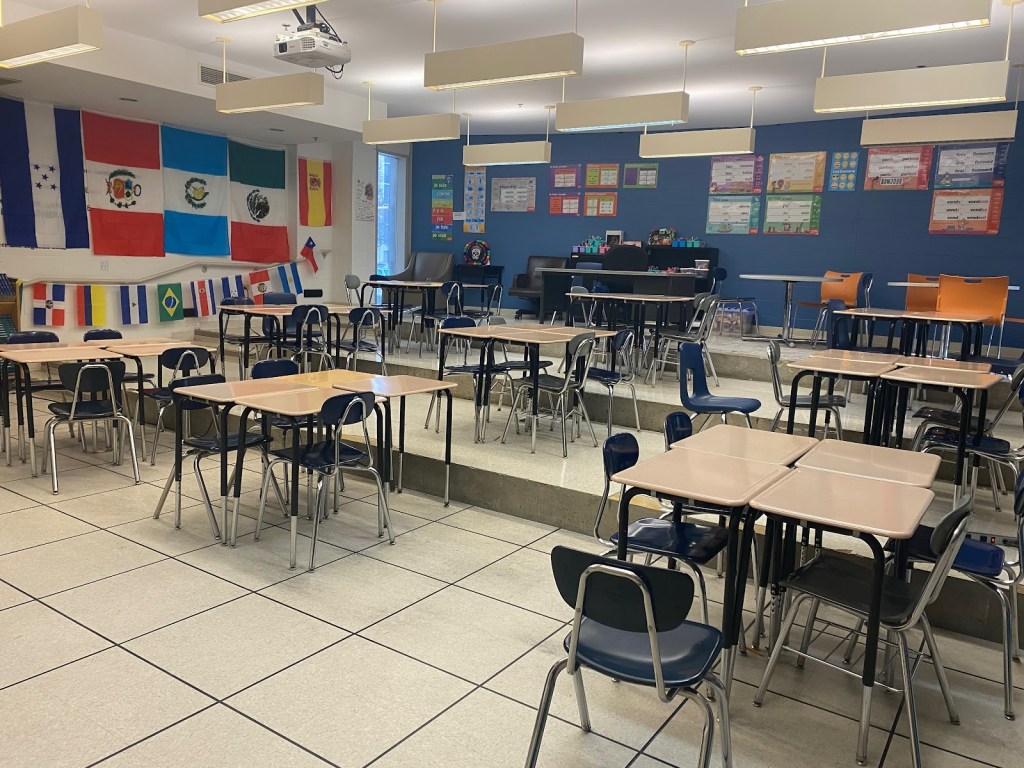
This year, I was lucky enough to participate in Payton’s French exchange program. I’m taking AP French—I’m sure my foreign language skills are as good as a French teenager’s, I thought. But when my exchange student visited in October, I wasn’t just impressed by his English; I was intimidated. Maxence could easily discuss history or politics in ways I’d struggle to work out in French. He explained that he’d taken English classes for several hours a week since he was five—and his Italian is pretty good too, as French students begin a third language in middle school.
The fact is that foreign language education in the US trails far behind other countries. Illinois is especially guilty: just 13% of our students study a language at all, and the state was ranked the 40th-worst state for language education nationwide, between Louisiana and West Virginia (neither of which are known for their great schools).
Part of the issue is that language education is consistently deprioritized, relegated to something that is “nice to have” rather than essential for students’ academic and professional success. Chicago Public Schools boasts that 100,000 of its students are learning a world language, but that means two-thirds of the total number are missing out.
Even when schools do teach foreign languages, they don’t necessarily do it well. My elementary school only offered half an hour of Spanish a week—so some of my friends took nine years of it and still only placed into beginning Spanish for high school. Meanwhile, Payton’s lucky to have great language teachers, but we can’t wait for high school to begin teaching languages; by that time, the crucial window for learning language is already mostly closed.
Plus, the limited choice of languages taught don’t serve certain groups well. I’m a native Spanish speaker, so I didn’t learn anything from taking basic Spanish in elementary school. It makes sense that most public schools—especially in Chicago, which is one-third Hispanic— teach Spanish. But the more Spanish speakers there are, the more languages need to be offered so that those students don’t get left out.
So, how can we better serve all Chicago students? One option might be for kindergarteners to be given a choice between two or more languages, which they would study through high school. Then, just like the European system, students could have the option to pick up a third language in high school.
Implementing this wouldn’t be easy, but Chicago has a strength in our large and diverse immigrant population. Actively recruiting immigrants to teach their native language in CPS would help fix the gap in adequately trained teachers. Sure, this might mean Tagalog and Ukrainian would be taught more than French and German—but that’s a feature, not a bug. We live in a city where more than 40 languages are spoken, and we deserve diverse language education to match that.
We constantly hear about the importance of STEM education to teach children how to innovate and, presumably, make piles of money later on. But language proficiency is an important professional skill too. Employers are increasingly in need of a multilingual workforce: 90% of American companies rely on employees with foreign language skills, but over 60% struggle to hire enough of them. Whether a student wants to become a scientist or a social worker, multilingualism is the skill of the future. If Chicago trains its children early to speak second and third languages, and to do it well, then there are no limits to the opportunities our city can unlock.


![[Photo Gallery] Homecoming Football Game Payton vs. Brooks](https://paytonpawprint.com/wp-content/uploads/2026/03/img_4761.jpeg?w=1024)
 The Paw Print
Leave a comment