

By Kieran Blake, Sports Editor
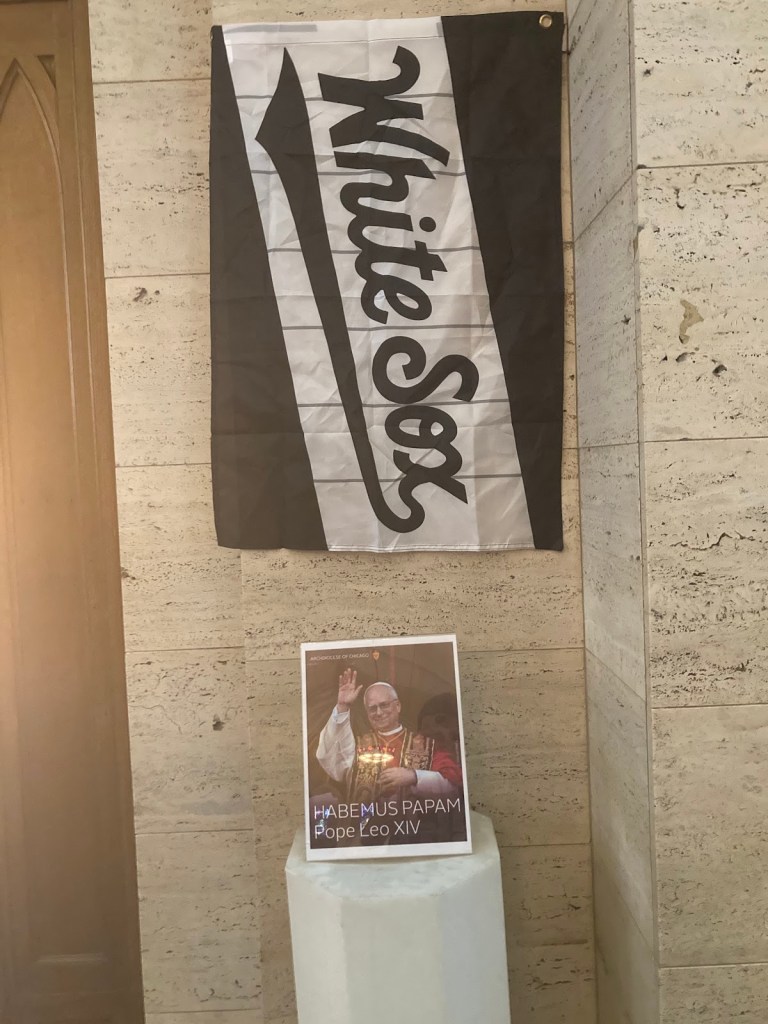
On day two of the 2025 papal conclave, white smoke had already billowed from the Sistine Chapel—the college of cardinals had elected a new pope. I sat in anticipation with my friends in front of a computer screen, awaiting the arrival of the new head of the Catholic Church. As we talked about who it could be, an older man walked out onto the balcony and announced the name. Not hearing it, we all began frantically checking the news on our phones and found that the new pope was an American. In disbelief, I tried to confirm whether or not this was true. I soon found out that it was—Cardinal Robert Francis Prevost, a native of Chicago who primarily did work for the Church in Peru, was to be the next pope.
In the Payton community, there was excitement over the fact that, much like most students at the school, the new pope was from Chicago. “It’s very cool that they chose an American pope for the first time,” said sophomore John Falciglia, adding that “choosing one from Chicago’s really cool.”
Junior Santiago Ortega-Chavez expressed a similar sentiment. “The fact that he’s from Chicago, I mean, that’s pretty exciting.”
Junior Tra’Monti Williams also shared that he thought it was “really fantastic that a big figure like the pope is coming from Chicago.”
Payton students were not the only ones celebrating the selection of a Chicago-born pope. During his Mother’s Day homily, Fr. Mike Gabriel, a pastor at Chicago’s St. Gertrude Catholic Church, declared that “the world has a new shepherd” who grew up on the South Side of Chicago to a congregation that then erupted with applause. “You can take the boy out of the South Side,” Gabriel continued, “But you can never take the South Side out of the boy.”
Mara Brecht, an associate professor of theology and the assistant chair of the theology department at Loyola University Chicago with a doctorate in theology, emphasized that it was “very meaningful to have not only an American pope, but also someone from Chicago.”
Rubén Rosario Rodríguez, an associate professor of systematic theology at St. Louis University with a doctorate in systematic theology, stated that he too was surprised by the selection of an American as pope. “Just last week, my department … had a round table discussion open to students, … and no one predicted it [the next pope] would be someone from the United States.” Rodríguez emphasized how it was “pretty amazing” that “just a normal kid who grew up in the South Chicago suburbs” who would “fit right at home as a parish priest in any middle class Catholic Church” has now become pope.
However, Rodríguez also shared that he felt that “the biggest challenge will be for a lot of American Catholics, because he’s not going to be America first. He’s going to be Christ first. … There are people in the U.S. whose nationalism and patriotism sometimes is more important than their religious identification and faith, and so that corner of the church is not going to be happy.”
While it is true that Prevost was in fact born in Chicago, he has spent much of his life abroad serving the Church. “I think,” said Rodríguez, “More than anything, the reason he was chosen, even though he was from the United States, is because he represents the global church. … He has dual citizenship in Peru, where he served for 15 years, eventually becoming bishop.
“By 2040, within our lifetime, we’re talking 40% of Catholics will live in Sub Saharan Africa. You know, estimates are that in China today, there are between 30 and 70 million, and in 40 to 50 years, that number could very easily quadruple. … Africa, Latin America and Asia have a predominantly Catholic presence. So in many ways, I think that’s what his selection represents. It’s almost as if he is a safe way for the Vatican to represent the global face of Catholicism, while at the same time trying to bring the United States into that global church.”
Brecht expressed a similar sentiment as Rodríguez. “The Catholic Church is truly a global church. Electing a pope who comes from outside of Europe is appropriate for a global church. … [Prevost] comes from Chicago, but he also served many years in Peru, and so in his ministry he links the global North and South and brings the perspective of the Americas to Europe.”
Prevost has been described by many as similar to Pope Francis. Both Prevost and Francis have been champions of both migrants and the poor, and while Prevost has in the past adhered more to traditional Catholic doctrine on issues such as the LGBTQ community than Francis, the two are still very similar. Rodríguez highlighted how Prevost is “very much like Francis. Maybe not as radical, maybe a little bit more boring, middle of the road, but nonetheless, really a cut from the same cloth of the Second Vatican Council.” (The Second Vatican Council was called for by Pope John XXIII during the 1960s with the purpose of “modernizing” the Catholic Church, so to speak.)
Brecht said that she was “very excited” that Prevost was “giving so many signals that he will continue Pope Francis’s legacy. … Encounter, bridge-building, interconnection, care for the Earth, dialogue, mercy and joy were hallmarks of Pope Francis’s papacy. If [Prevost] expands and extends these values, it will mean a Church that is increasingly concerned with the world around it, with facing outward rather than inward and with joyfully serving the needs of the Earth and the world.”
For his papal name, Prevost selected Leo in honor of Pope Leo XIII. Rodríguez pointed out that Leo XIII “was the founder of Catholic social justice teaching and a famous encyclical called Rerum Novarum from 1891, which committed the Church to siding with labor unions and providing livable wages and safe working conditions.” Prevost’s papal name could indicate a continued commitment to the working class during his pontificate.
Another key aspect of Francis’s tenure as pope was the welcoming of non-Catholic faiths. When asked whether the new pope will continue to be welcoming toward other faiths, Rodríguez, himself a Protestant, shared that he believes that Leo XIV will. “[Prevost] is an Augustinian. … Martin Luther, who was the founder of Protestantism, was an Augustinian and when you read the work of the 16th-century Protestant reformers, St. Augustine was the most cited theologian in their works. … For most Protestants, this is good. This is positive. This is someone who they can respect and they can see as the kind of humble servant that Christ was and have no qualms working to continue to build bridges with the Catholic Church.”
Rodríguez also shared that he believes the Eastern Orthodox Church is “very happy with [Prevost’s] selection as well, because they feel that Francis built a lot of bridges towards unifying east and west, and they think this pope might continue in that direction as well.” Overall, while the exact stance that Leo XIV will take on other faiths remains to be seen, signs are currently pointing to a continuation of Pope Francis’s policy of acceptance and goodwill.
Another trait of Leo XIV’s that is similar to that of Francis are his already-numerous pleas for peace around the world. Francis actively worked toward peace in Ukraine and Gaza during his pontificate, and it looks as though Leo XIV will continue Francis’s work. Prevost’s first ever words as pope were, “Peace be with all of you!” He has since spoken of the need for peace in his first few homilies, pointing again to a continuation of Francis’s work.
The exact direction that Leo XIV will take the Catholic Church during his pontificate still remains to be seen. That being said, many express optimism for the future with Leo XIV as pope. “I’m really excited to see what the whole new pope situation is like,” said junior Connolly Nugent. The Catholic Church today stands at a pivotal moment in its history, and the direction that Leo XIV will take the Church could shape Catholic faith and doctrine for the next few decades.

![[Photo Gallery] Homecoming Football Game Payton vs. Brooks](https://paytonpawprint.com/wp-content/uploads/2026/03/img_4761.jpeg?w=1024)
 The Paw Print
Leave a comment