

By Kieran Blake, Editor-in-Chief
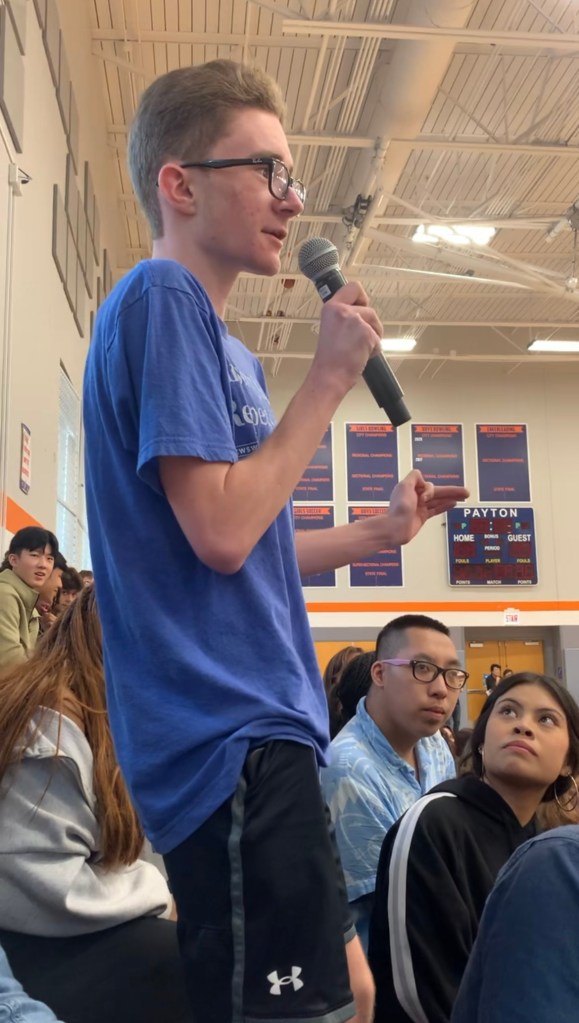
There are few things during my time at Payton that have caused more controversy than the introduction of Payton’s new digital hall pass system, Minga. Never before have I heard “boos” from every corner of the gym echo through the air during a town hall like they did last Friday.
The student body is angry, and they want answers. How much did Minga cost? Whose idea was it? What was wrong with the previous hall pass system? Does Minga violate students’ individual liberties? Does Minga place a time limit on students using the bathroom? Will Minga track students’ locations? Do students have to download an app on their phones to use Minga?
I do not have all these answers. Administration says Minga costs roughly three dollars per student, which would add up to around $3,795 in total. While not as much as previously thought, that is still quite a large sum of money. To confirm these numbers, The Paw Print has submitted a FOIA request to find out exactly how much was paid for Minga. Students do not need to download an app on their phones, and their locations will not be tracked. Nevertheless, there have been concerns raised about Minga by both students and staff at Payton.
Even if Minga will not track students while they use the bathroom, it still places unnecessary restrictions on students while they do so. Digitally monitoring the time students take may force students to defend themselves from assumptions and accusations that they were “wasting time” when their bodily functions simply took longer to execute. Sometimes, for whatever reason, a student is forced to take a longer time in the bathroom. It is unfair to punish or instill fear of punishment in students for circumstances that are out of their control. Students generally should also not have to worry about the time it takes them to use the bathroom.
Additionally, digitally monitoring how often and how long students use hall passes fosters a lack of trust among the student body and administration. Minga’s implementation makes me feel as though administration views the student body as untrustworthy. At a high school so highly-regarded as Payton, should the majority of students not be trusted to act responsibly? I personally believe that students deserve a degree of responsibility that administration is not giving them.
I recognize that there is a problem with students abusing the hall pass system. However, those same students who abuse physical hall passes will also abuse Minga. They will find some loophole around Minga (or frankly just not care), and ultimately, the only people who suffer will be the students who were already following the rules in the first place. Additionally, the vast majority of Payton students are not wandering the halls or camping out in the bathroom during class time. As the saying goes, do not let a few bad apples ruin the bunch.
Returning again to the financial component, it is illogical to spend thousands of dollars on a system that will likely have little impact (if any) on student behavior. In a time when the federal government is already cutting funding for public schools and our COVID relief money is running out, why are we using what little funds we have on a costly system that serves little real purpose while simultaneously stirring up student frustrations toward administration?
Parts of the bathrooms are dysfunctional. There is a hand dryer on the second floor that does not work, stall doors in the west building cannot close properly and paper towels are often scarce. While I have been informed that the urinal issue requires separate attention, there are still many other improvements that money could have gone to. Better yet, it could have been saved to put toward a feasible solution when a more-pressing issue arose.
Students are not the only ones who are confused and frustrated. While I will not name names, numerous teachers informed me they were not consulted about Minga and found out in roughly the same way we did—through an introductory video. If the problem was that teachers could not control students leaving the classroom and wanted to prevent students from abusing the hall pass system, would it not have made sense to consult them first? But no, instead of discussing with teachers exactly what the problem was and coming up with a solution, administration instead sprung upon teachers a new system which they never asked for.
Now to Vice Principal Paul Arabie’s credit, he did say during Friday’s town hall that administration would re-evaluate Minga if it does not seem to be working and “blows up in our face.” He did also say that he much prefers the student-created and -managed enrichment system of Selenium to Minga’s optional similar service. And most importantly, he allowed students the opportunity to air their concerns directly to administration Friday, and for that, I commend him. Administration will again host a forum this Wednesday after second seminar where students can air their concerns and ask any questions they may have, and if you do have questions, I highly recommend you ask them there. Administration, to their credit, is trying to make sure the student voice is heard.
Was there a problem with the hall pass system? Yes. Did something need to change? Probably. But Minga is a system that nobody asked for and nobody wanted. Countless students and teachers seem to prefer traditional hall passes to Minga’s electronic alternative. Rather than spending thousands of dollars when funds are already scarce, restricting student freedoms, damaging administrative credibility and ultimately punishing 1,265 students for the misjudgments and misbehavior of a select few, administration should have consulted teachers and even student leaders (LSC and student government) to come up with a comprehensive and well-meditated solution that would serve to benefit all.
I respectfully urge administration to reconsider their use of Minga and seek an alternative solution to the hall pass problem. And I urge all of you as students to actively take part in shaping that change and that solution.

![[Photo Gallery] Homecoming Football Game Payton vs. Brooks](https://paytonpawprint.com/wp-content/uploads/2026/03/img_4761.jpeg?w=1024)
 The Paw Print
Leave a comment