
By Rehan Mathew Koshy, Staff Writer
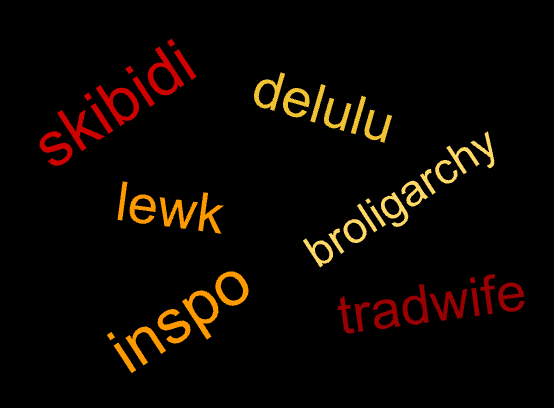
We’ve all had that moment when we’re reading a great novel, and out of nowhere, a word that we don’t know catches our eye. Usually, our friend, the dictionary, is there to help us out. But after Cambridge Dictionary added its latest entries, providing official definitions for words like “skibidi,” “delulu,” and “broligarchy,” the dictionary is straying further and further from its traditional usage, instead choosing to embrace internet culture and slang to a greater extent. And the internet has mixed feelings about it.
The entry that captivated the internet the most is “skibidi,” a gibberish word coined by a viral nonsensical YouTube animation. The word notably lacks an exact definition. According to Cambridge Dictionary, it is “a word that can have different meanings such as ‘cool’ or ‘bad,’ or can be used with no real meaning as a joke.”
“Delulu,” on the other hand, is noteworthy due to its use by Australian Prime Minister Anthony Albanese when attacking his opponents in Parliament. The word itself is just a shortened, humorous version of the word “delusional,” but its playful reframing of this negative term into a more positive one has led to its rapid rise in popularity.
According to Colin McIntosh, the lexical program manager at Cambridge Dictionary, “Internet culture is changing the English language and the effect is fascinating to observe and capture in the Dictionary.” Cambridge Dictionary has committed to keeping up on the latest trends, and it’s not alone in this endeavor. Merriam Webster has added its own “Slang & Trending” section recently, adding similarly bizarre words like “opps” (meaning opponents), “cooked” (doomed), and “looksmaxxing” (efforts, sometimes extreme, that young men take in order to look more attractive).
Ethan Lao ’27 stated in an interview, “Skibidi should not be a word. It has no real definition.” However, Tobiah Collins-Sussman ’27 says, “I don’t think it’s been enough time to truly know if it’s a word that will stick around in the English language, or if it’s just a fad to use gibberish humorously.”
It’s quite interesting to see how slang and internet culture are slowly transforming the very way we speak, and it makes one wonder what regular conversation will look like in ten years or so. Maybe English vocabulary will be “lit,” or maybe it will be quite the opposite, and our lexicon will be “cooked.” Either way, it’s fascinating to think about what the future holds for the English language.
![[Photo Gallery] Homecoming Football Game Payton vs. Brooks](https://paytonpawprint.com/wp-content/uploads/2026/03/img_4761.jpeg?w=1024)
 The Paw Print
Leave a comment