
By Rehan Mathew Koshy, Staff Writer
When we think of Chicago, one of the first things that comes to mind is its picturesque skyline. The Willis Tower, the John Hancock Center and the Trump Tower are just a few of the structures that touch the sky, and we are lucky to call this city our home. However, right in the heart of Chicago is another gem that often goes overlooked — Chicago’s Millennium Park.
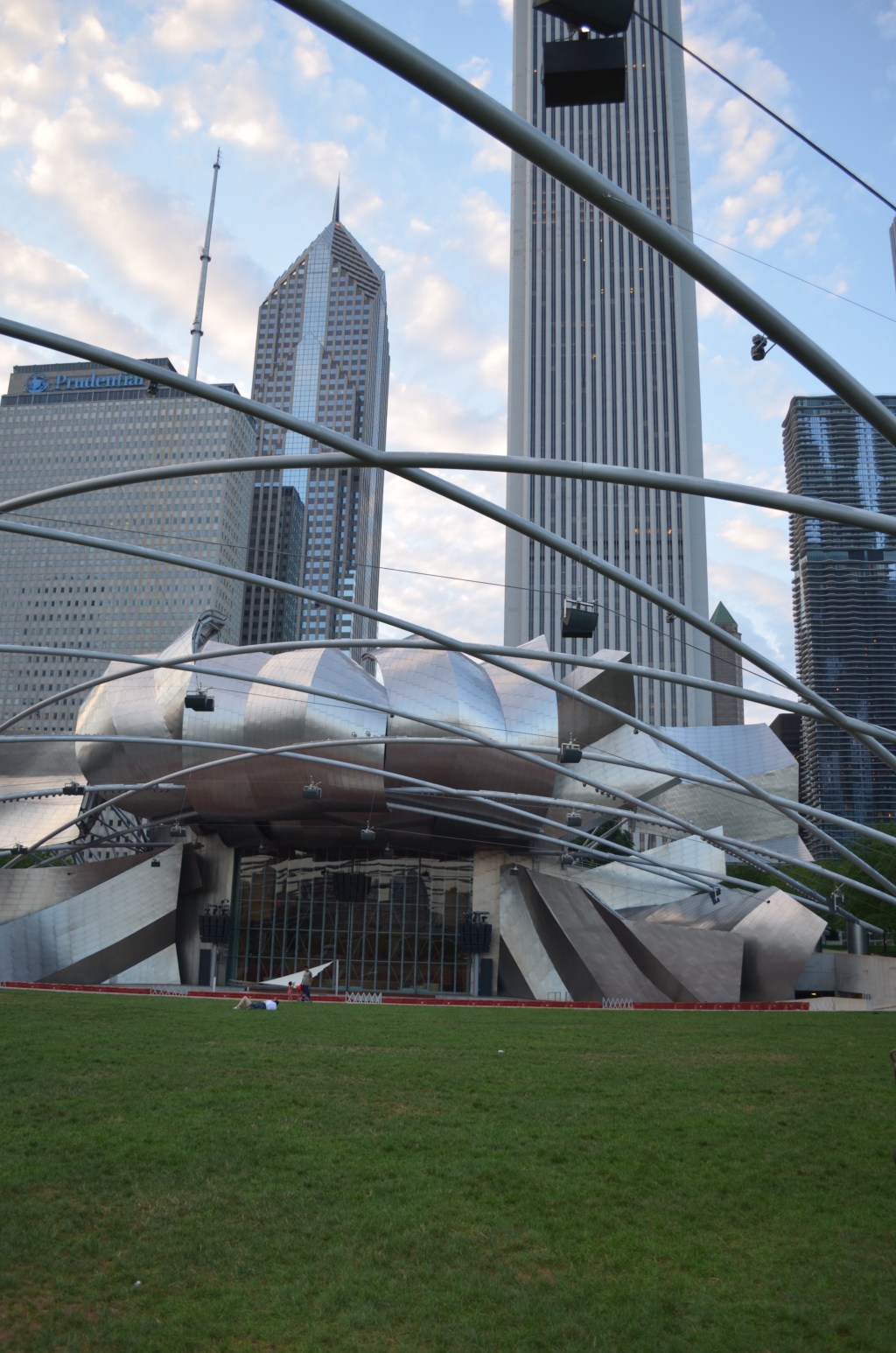
One of the park’s most striking features is the famous Jay Pritzker Pavilion, completed in 2004 and designed by renowned architect Frank Gehry. As of December 5, the city has lost one of its most visionary creators. Gehry’s bold designs and lasting impact on not only Chicago, but also the world, will continue to inspire for generations to come.
Gehry was born Frank Owen Goldberg on Feb. 28, 1929, in Toronto, Canada. He later changed his surname and rose to become one of the most influential architects of the 20th and 21st centuries. After studying architecture at the University of South Carolina and later at Harvard’s Graduate School of Design, he worked for several firms before opening his own firm, Frank O. Gehry & Associates in 1962.
Throughout his career, Gehry began experimenting with forms and materials, and was arguably one of the most famous architects associated with deconstructivism in architecture, a quality that stemmed from the design of his iconic buildings like the Guggenheim Museum Bilbao and the Walt Disney Concert Hall.
Despite his global fame and Chicago’s long-standing reputation as an architectural capital, Gehry’s connection to Chicago was unique and deeply influential. The Jay Pritzker Pavilion boasts curves of stainless steel that soar over a hundred feet into the air. Gehry has given our city a beautiful stage, designed to accommodate large choirs and orchestras and serving as the center of Millennium Park. Gehry also designed the BP Pedestrian Bridge to Chicago’s rich architectural landscape. Clad in stainless steel, it spans Columbus Drive to connect Maggie Daley Park with Millennium Park.
Gehry’s work in Chicago reflects the essence of his career: fearless creativity, technical mastery and an unwavering belief that architecture should move people both emotionally as well as physically. His designs challenged convention, redefined public space and demonstrated that buildings could be both functional and expressive. While the world mourns his passing, his legacy endures in steel, glass and everlasting creativity. In Chicago and beyond, Gehry’s vision will continue to inspire architects, artists and dreamers for generations to come.

![[Photo Gallery] Homecoming Football Game Payton vs. Brooks](https://paytonpawprint.com/wp-content/uploads/2026/03/img_4761.jpeg?w=1024)
 The Paw Print
Leave a comment