

By Isabella Sun, Associate News & Features Editor
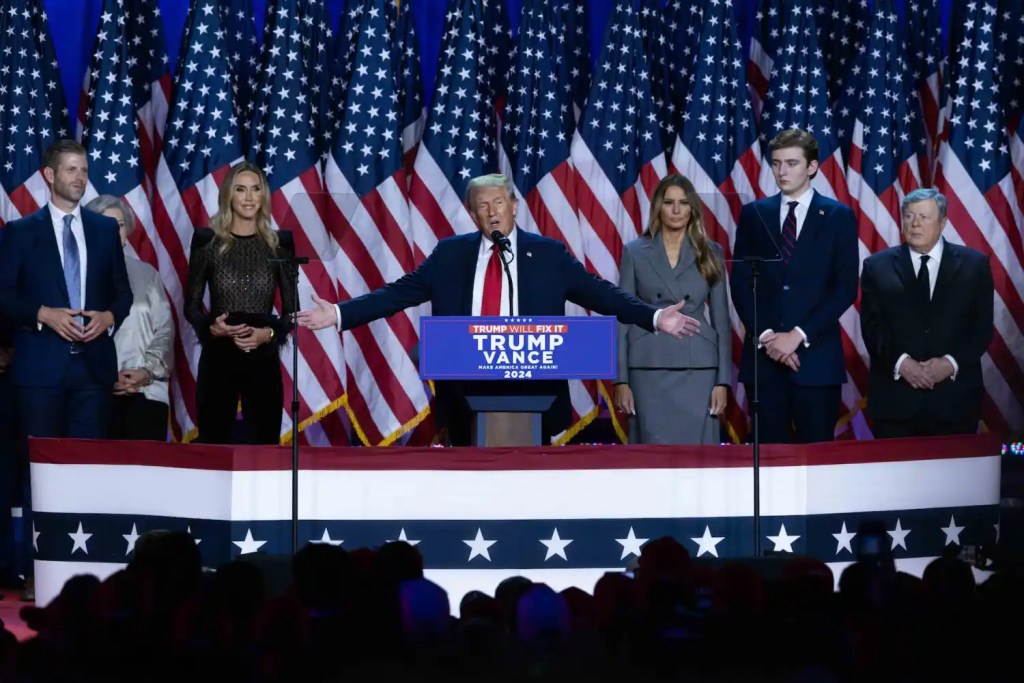
At 2:24 a.m. on Nov. 6, Donald Trump declared his election victory surrounded by his supporters, advisors, family and friends. Although the Associated Press had yet to call the race, it was clear that Trump had won all seven swing states –Arizona, Georgia, Michigan, Nevada, North Carolina, Pennsylvania and Wisconsin – leading him to win the 2024 presidential election, 312-226. To his supporters, Trump said, “We’ve achieved the most incredible political thing. America has given us an unprecedented and powerful mandate.”
The result of his campaign was stunning. Trump flipped Nevada, Arizona, Wisconsin, Georgia, Michigan and Pennsylvania from blue to red. There were numerous factors that led to Trump’s victory, many of which were the decisions made by his top aides. To them, a summary of Trump’s campaign can be simplified to this: “Max out the men and hold the women.” This meant emphasizing the economy and immigration while shifting focus away from abortion and the assault on American democracy four years ago. Also, the Democratic campaign and performance the past 4 years also contributed heavily to election day.
Similar to Trump’s 2016 victory over Hillary Clinton, the outcome of the 2024 election was heavily dependent on the declining economy. More specifically, many voters were unsatisfied with the high inflation rates under the Biden administration. Though immigration was an important issue, as Republican strategist Rick Gorka said, “The economy trumps everything. No pun intended.”
In his campaign, Trump stated that he would “end inflation and make America affordable again” and would carry out “large tax cuts for workers and no tax on tips.”
With a focus on the economy, the Trump team built on Republicans’ growing strength among white working-class voters, creating a multi-ethnic working-class coalition. His share of Black, male voters increased from 12% to 20%.
Despite his last phase of his campaign, Trump still found success with Hispanic voters. An invited speaker at his rally shouted insults to Latinos and Puerto Ricans while also making awkward comments about female voters. If the exit polls are accurate, Trump increased the number of Latino male voters in Pennsylvania from 27% to 42%. Nationally, Trump’s support among Latino’s increased from 36% to 54%.
Latinos and African Americans most likely voted for Trump because Democrats did not deliver on their promises of prosperity for their community. As a result, many decided to try their chances on Trump, giving him a shot to see whether they will benefit from him.
Trump’s campaign specifically focused on mass deportation of illegal immigrants, highlighting the economic and social consequences from illegal immigration. He said that he would “seal the border,” “stop the migrant invasion” and “carry out the largest deportation operation in American history.”
American voters are split on the topic of illegal immigration, where 41% of all voters believe illegal immigrants should not be allowed to stay in the country legally. This, however, is a rise from 2021, where only 31% said so, a 10% jump. 63% of Republican voters now favor a national deportation effort, up 50% from three years ago. About 11% of Democratic voters favor this, up 5% in the same period. Although not substantial, this was also a factor that played into the election results.
Trump also had his fair share of lucky moments. When Trump started his third campaign for office, most Republican leaders ignored him. As a result, he had the whole Republican party essentially supporting him. Additionally, he was able to shrug off his 34-count felony conviction and other criminal indictments. Friendly judges pushed his criminal trial after the election. Liz Mair, an anti-Trump Republican strategist said Trump succeeded in “getting people to forget about January 6.”
Until July, Trump’s opponent was an 82-year-old, unpopular incumbent president who was believed to be too old for the job. After a disappointing presidential debate with Trump, Biden was hastily replaced with Kamala Harris.
The Harris campaign also struggled with gaining support. She served as vice president to Biden, a president whose approval rating plunged in his first year as presidency and never improved. Harris inherited this disapproval when Biden stepped down from the elections. By waiting until July 21, 2024, Biden hindered the Harris Campaign. With only around three months to prepare for the elections, she did not have much time to introduce herself to voters.
Harris’ tactical choices made her image worse. Harris didn’t create her own image for voters and stuck with Biden’s unpopularity which burdened her campaign. She refused to explain why she abandoned progressive positions on crime, immigration, health care and climate change. This led the Trump campaign to accuse her of being a radical.
She also avoided media interviews during the first half of her campaign, creating an impression that she was not quick to think on her feet. Answering tough questions enhances candidates’ reputations, something Harris did not do. As voters have said, Harris is an “empty vessel.”
A middle-aged Florida voter said, “She’s not distanced herself from Joe Biden. She’s just following the path Joe Biden has been on the past four years.” Voters pointed out that they didn’t know enough about her presidential plans. An Idaho woman said, “I feel that she does not get deep into the problem, like immigration. I feel like she says a bunch of smart words, but I do not get an answer, like with the economy. Her vocabulary is really good, but I do not get an answer.”
Harris’ election theories were also flawed. Based on the 2022 elections, she focused her agenda on reproductive rights and abortion, believing that her agenda would mobilize groups of female supporters and move them to the polls. However, the amount of women who voted for Harris didn’t increase from Biden’s 2020 campaign. Trump actually was ahead of Harris in exit polls for women voters, especially white women. Although Harris had a 10% lead ahead of Trump among women between the ages of 18 to 44, according to a preliminary polling from AP VoteCast, women above the age of 45 tended to vote for Trump.
Whether or not you support Trump, it is undeniable that Trump’s campaign strategy was incredible. The difference between Trump and Harris was not close. Trump won 77 million votes, 2 million above Harris. This was also a 3 million increase from 4 years ago in the 2020 presidential election. Prior to this election, George W Bush was the last Republican other than Trump to win the popular vote. That was 20 years ago.
Trump will be challenged to uphold the promises he made during his campaign. Many things are still uncertain. It is unknown whether or not he will be able to impose massive tariffs without raising inflation. It is also uncertain if he will be able to quell conflict in Ukraine and the Middle East as quickly as he claims. His possible deportation may or may not create civil strife and backlash among Latino voters. If he fails to meet the expectations placed on him, the Republican party may suffer in 2028, but if he’s successful, the Republican party may dominate for years to come.










Leave a Reply