

By Steven Jiang, Associate Opinions Editor
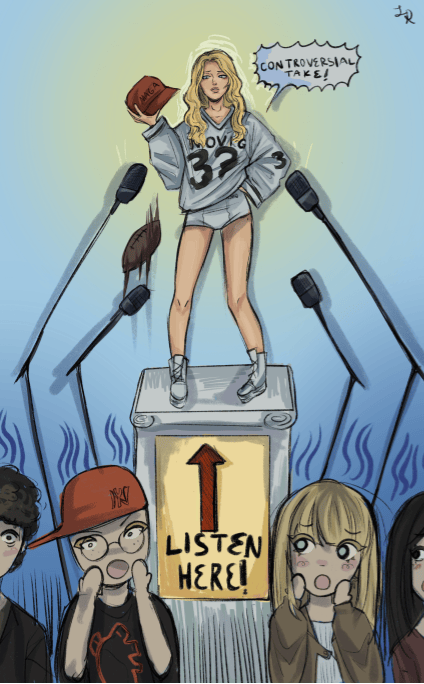
What if I showed up to school wearing a red MAGA hat?
Growing up in the Democratic stronghold of Chicago, I’ve been immersed in blue my entire life. It screams in my face every election season, from the plastered ads on billboards to the ubiquitous yard signs in my neighborhood. In school, I always felt as if my classmates and teachers all embraced the same political culture. Anyone that deviated from the norm was subject to both verbal and implied judgment that often got personal. Never mind the fact that most of us didn’t watch the news and knew ridiculously little about politics. We were told to embrace diverse perspectives, but everyone seemed to agree with each other and share similar views.
Personally, as a Democrat and a board member of the high school Democratic organization in my state, I accepted this climate for a long time. However, I would sometimes wonder what things would be like if they were the other way around. There were times like when a teacher was placed under investigation by CPS for raising questions about the Trayvon Martin case and suggesting that the controversial verdict was correct. But if I was never going to be in a situation where I stood against the crowd as a lone dissenter, why did it matter to me? Everything would be a lot simpler if we pretended as if we had no political differences and that one viewpoint was held to be the unquestionable truth.
The real world, as it turns out, expands far beyond the comfort and illusion of uniformity. Many of my peers expressed their true political beliefs in private, views that touched on hot-button issues like LGBTQ rights and affirmative action. They always spoke in whispers and cast furtive glances around the room, as if they had violated an unwritten rule by speaking their minds. We couldn’t have conversations about certain topics that were deemed too controversial or likely to offend others. It was a hostile culture that threatened our freedom of speech and instilled a sense of guilt in those who disagreed with it.
It’s easy to extol the virtues of diversity, belonging, and freedom of speech in our schools. It’s much harder to listen to and respect someone whom you vehemently disagree with, especially with political polarization at an all-time high. But even the smallest minority must be protected, and no one should be forced to “fit in” with the rest of the crowd.
The solution to promoting political diversity in our schools must start from being willing to disagree. We must tolerate all opinions, as long as they do not personally attack any individual or particular group. New York Times columnist Bret Stephens explained it best in his op-ed about the “dying art of disagreement” in our modern political climate. To have meaningful discourse, we have to be comfortable with being uncomfortable. Furthermore, it’s important to distinguish between political views and the people that hold them. Debates today too often veer into personal attacks instead of substance, and we tend to negatively label people subconsciously when we disagree. Case in point, if you automatically associate a MAGA hat wearer with racism and bigotry, you’re making assumptions that hinder your ability to understand their perspective.
With the election season now behind us, there’s bound to be discourse. Instead of shying away from “controversial” and “sensitive” topics, we should encourage thoughtful discussions.
We must truly foster an environment where youth can have productive debates and think independently without fear of repercussions. When we break down the barriers of self-censorship, we’ll shift towards a culture that is more tolerant of our differences, one that encourages speech rather than silence and more open questions instead of predetermined answers.


Leave a Reply