

By Beatriz Whitford-Rodriguez, Staff Writer
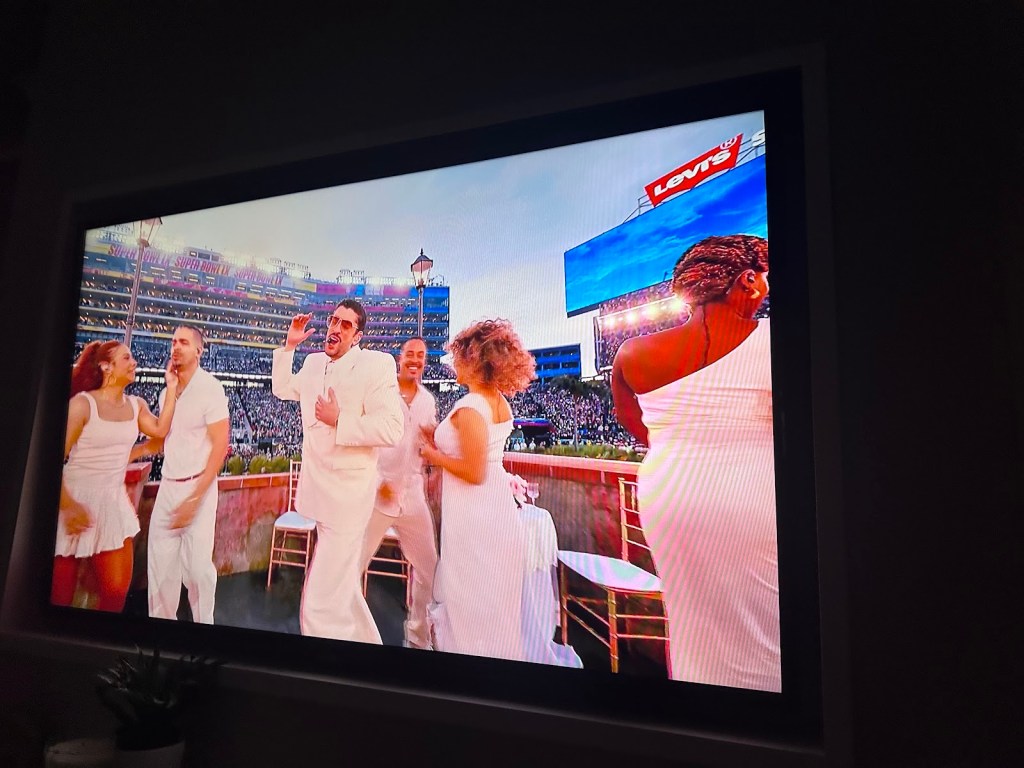
Whether or not you consider yourself a football fan, and whether or not you have ever heard a Bad Bunny song, at this point it is inevitable: you know that Puerto Rican musician Benito Antonio Martínez Ocasio was the halftime performer at Super Bowl LX on Feb. 8, 2026. And, in this uncertain time in our country’s history and frightening time to be Latine, his performance was, dare I say, perfect.
Bad Bunny took the stage in a stadium filled with what looked like sugarcane trees; in fact, each stalk was an individual performer. He then began a 13-minute journey incorporating 18 different songs that spanned musical genres and styles, traveling not just through Puerto Rico, but across Latinidad more generally. This sequence included cameos by stars like Cardi B, Karol G and Pedro Pascal and references to essential facets of Latine culture communicated through intimate and familiar scenes such as two women gossiping at a nail salon, a young boy falling asleep on a row of lawn chairs and an appearance by Toñita, the owner of one of the longest-running Puerto Rican social clubs in New York City.
One especially heartwarming moment came as Bad Bunny approached a young boy sitting in front of a TV screen. He handed the boy a Grammy Award – Super Bowl LX coming, of course, on the heels of his Album of the Year award for “Debí Tirar Más Fotos” – and reminded him (and all of us, since he spoke directly to the camera) to believe in ourselves. It later emerged that the boy had been dressed as a young Benito in a beloved family portrait, making the scene that much more touching.
Beloved Puerto Rican singer Ricky Martin also appeared, singing Bad Bunny’s anti-colonial song “Lo Que Le Pasó a Hawaii”! And the much-speculated-upon guest star was Lady Gaga, singing “Die With A Smile”! To me, this collaboration effectively blurred cultural lines, offering subtle rebuke to those who criticized a Spanish-language halftime show. Culture isn’t an exclusive experience, Bad Bunny and Lady Gaga suggest by singing together; it’s something we can all share, embrace, and collectively find joy in. Speaking of joy, Bad Bunny even staged a wedding halfway through the show, one which turned out to have been real and legally binding! I initially thought this bizarre, but have come to the conclusion that it was the logical progression of the intimate, celebratory event Bad Bunny created for us: If the world feels full of hate, what is there to do but to put an ultimate gesture of love on display?
Bad Bunny closed by saying, “God Bless America,” then listing every country in the Americas concluding that “together, we are America” in front of a sign that read, “The Only Thing More Powerful Than Hate is Love.” This echoed a sentiment he expressed in his acceptance speech at the Grammy Awards a week prior, driving home one of the main ideas behind the show: he, a Puerto Rican man, is American; we are all Americans. We belong.
Before watching the halftime show, I had only ever heard a handful of Bad Bunny songs; as soon as he took the stage, I was enthralled. As the daughter of a Venezuelan immigrant mother, perhaps it meant more to me to hear someone singing in Spanish in front of a Super Bowl audience; still, I don’t think you needed to speak Spanish or be Latine for Bad Bunny’s show to mean something to you. Some things are universal; love is one of those things. In this time of uncertainty, it feels like we always have to be prepared for whatever ugliness might be around the corner. I can’t tell you what that will be, or how you can deal with it. But I can tell you two things: The only thing more powerful than hate is love, and Bad Bunny’s halftime show was all love.


Leave a comment