

By Addison Davis, Staff Writer
This Review Contains Spoilers.
I recommend watching the movie for yourself before reading.
“Bugonia” is a Stellar New Alien Conspiracy Film – by Addison Davis
★★★★☆ [4 / 5 stars]
#bugonia, #reviews, #yórgos lánthimos, #movies
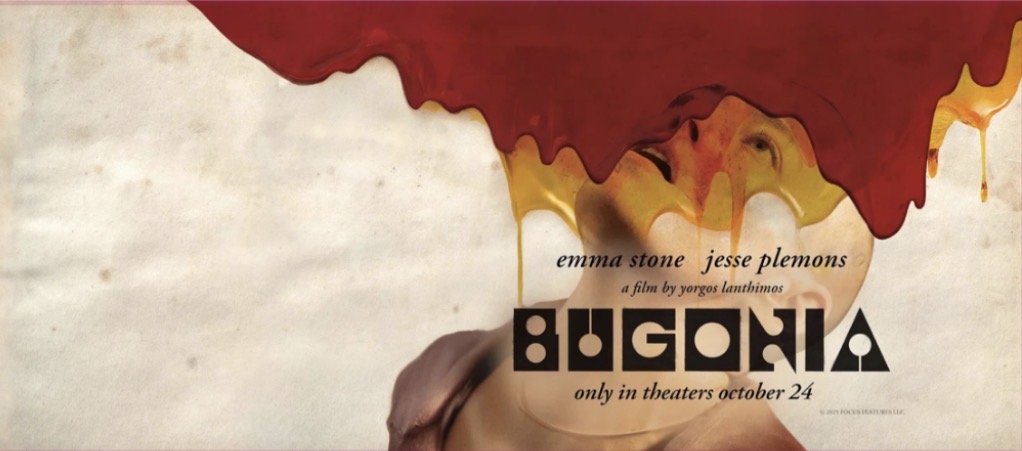
“Bugonia” is Yórgos Lánthimos’ newest film and a remake of Jang Joon-hwan’s “Save the Green Planet!” (2003). Although I have not seen “Save the Green Planet!”, after doing some research on the film, it seems the two plots are nearly identical. The plot of both revolves around the protagonist and his sidekick kidnapping a CEO who they believe is an alien (Michelle in Lánthimos’ version, Kang Man-shik in Joon-hwan’s). The main difference is the main character’s sidekick; in the 2003 film, the main character’s sidekick is his girlfriend, and in the 2025 remake, the sidekick is his cousin.
In the first few minutes of “Bugonia”, in addition to the main character Teddy, a crazed skeptic who believes that aliens are real (and, as we later find out, tried to kill his mother), we are introduced to Don, a character who very clearly has a mental disorder (though it is not specified what exactly is wrong with him). As far as I can find, Don’s existence is the main difference between “Bugonia” and “Save the Green Planet!”. This makes the character all the more interesting.
As Teddy drags Don along as they prepare to kidnap an “alien”, we see their dynamic quite clearly: Teddy emotionally manipulates Don, saying that doing this for him is the only thing that will “fix” him. Teddy recounts the fact that he and Don have lost everything and all they have is each other as Don is getting ready to inject a mysterious substance into his body (the movie never fully clarifies what is in this substance). Teddy pushes the needle in, and Don later says that whatever was in that vial has made him feel angry and wrong. This truth is, it doesn’t matter what was injected; it represents the harm that conspiracy theories do to people mentally. Teddy later says that the pain will go away, but it clearly hasn’t for him. The needle is also quite fascinating because it is entirely ironic for Teddy to want to use a needle for anything. Needles killed his mother as shown visually halfway into the movie. They are clearly a source of trauma for him, and yet, he forces his cousin to use one as well as using it on himself.
Teddy treats Don mostly as if Don were a child who could not think for himself, which feels very condescending. Sometimes Don is also used as a humorous device. While I will admit I laughed at the scene where Michelle and Teddy are having an extremely tense moment and Don breaks the tension by asking if he can go to the bathroom, it is something that you need to be extremely careful with. Disabled people shouldn’t be used as the butt of the joke, and I wish Don were treated with more care.
However, I think the movie makes an important point about emotional manipulation and reliance, specifically regarding neurodivergent and disabled individuals. There is a moment in the film where Teddy claims that Michelle is trying to emotionally manipulate Don. The irony comes from the fact that Teddy is doing the exact same thing; even though Michelle did turn out to be an alien, and mostly everything Teddy said turns out to be true, Don still commits suicide (though he did not actually learn if Michelle was an alien or not). Don thinks he has nothing because Teddy manipulated him into thinking so. He thinks Teddy is about to be arrested, and even if he does walk free, he will have nothing because of what Teddy said to him earlier. Michelle blames Teddy directly when he finds Don’s body. And the thing is, she is right. That is exactly why Teddy is so triggered when Michelle brings up his mom earlier in the film — he has experienced so much trauma he would rather believe aliens are real than the reality of this cruel world. He would rather harm everyone around him than face the truth.
That is why Teddy is so bent on Don believing his conspiracies. Teddy needs someone to validate him, and he uses Don as a puppet to project his beliefs onto. It is quite sad, really, but certainly a fascinating commentary on how we treat disabled people, specifically people that are supposed to be our peers yet we demean them and tell them what to think. We think we know better because we are “normal”, and Teddy even implies to Don that there is something to be “fixed” about him, that his disability can be “cured.” It is just one sad aspect in this movie full of heartbreak.
The movie is also generally quite tense. There are multiple moments where both Michelle and Teddy are about to die, and the build up of this tension is underscored by the music — it keeps you on your toes, wanting to know what will happen next. Sometimes the score swells up during moments of seemingly nothing happening, like scenes of Teddy just riding his bike, to keep up the tension during seemingly unimportant moments. The use of music helps the viewer know that something is about to happen or that a character has realized something important.
While I did appreciate the score, I was a bit confused at some points, and I think they could have been more subtle with some parts. Having a character have an important revelation can and should be underscored with music, but I personally think at some points it was too intense and gave too much away. Either way, I thought the score, composed by Jerskin Fendrix (who also did some of Lánthimos’ other films), was quite good and definitely sounded space-like.
There are a couple other songs that play in the film, but the song that stood out to me the most was in the final moments of the film. Flashes of random humans frozen in time — working, going to school, etc who have dropped dead mid action — appear on screen set to the sound of Marlene Ditreich performing Pete Seeger’s “Where Have All The Flowers Gone.” It was written during the McCarthy era, which makes sense because this movie definitely reminds me of the Cold War era in America. Aliens specifically spoke to our fears during the 1950s due to the idea of conformity (“Invasion of the Body Snatchers”) and distrust of our neighbors (“The Monsters Are Due on Maple Street” from “The Twilight Zone”, which technically released in 1960 but still is reflective of this era). A modern-day horror about aliens certainly is influenced by these pivotal films and shows from 70 years ago (credit to Julian for their insight on this). “Where Have All The Flowers Gone” is specifically about fallen soldiers but is very universal in its themes. I think the line in Dietrich’s version that speaks to this movie the best is, “When will they ever learn?” — a melancholic statement about war and humanity. The Vietnam War began not even 10 years after Seeger wrote this anthem, showing the cycle of war and human evil persisting. I think the use of this song is Lánthimos essentially finalizing an idea he spent the entire film building: that there is a war going on within ourselves. The war of human nature. Teddy is deeply traumatized due to the evils of the other humans around him: his old babysitter, who is implied to have abused Teddy in some way; the company that sold his mother a product that ended up slowly killing her; the doctors who have failed his mother; his father who left when his mother got sick; and so on. Instead of trying to make peace with all of this, he continues the cycle of abuse by torturing and murdering others.
The visuals depart from Lánthimos’ other films, such as “Poor Things.” “Bugonia” is much more grounded in reality (aside from the last 15 minutes, of course), and so the visuals are very real; it doesn’t feel as fantastical. This story is real, which is part of what makes the last 15 minutes so jarring. The only other fantastical visuals we see in the film are the scenes of Teddy and his mother, in which his mother is stabbed with needles all over, floating indefinitely above Teddy as Teddy holds onto her like a balloon. These visuals are clearly meant to represent Teddy not being able to let his mother’s death go. (Technically she is still alive, but she has been in a coma for the past 15 years in the context of the film.) I quite enjoyed these Lánthimos-esque visuals and honestly, it was quite beautiful through the sadness of it all.
These fantastical visuals are also present in the ending when Michelle turns out to be an alien and goes to her spaceship. The spaceship is very pink and red, and the aliens are dressed in giant sweaters but are humanoid. Michelle ends up popping this bubble around a flat Earth, a visual we’ve seen as a title card as days pass (“__ days until the lunar eclipse” cards are shown after each day is done as the Earth gets flatter and a white light in the top-left corner gets brighter). It seems these title cards have been hinting at this ending all along, and after she pops the bubble, all humans immediately drop dead.
This movie speaks to the concerns of today’s world in a lot of ways. Many people are losing faith in humanity. Many are losing hope in our messed-up system where it seems it is impossible to survive without losing part of yourself. Late-stage capitalism has made everything feel fake and surreal. Teddy is horrified when Michelle analyzes his behavior because he knows it is true, and in some ways, a lot of us are Teddy: someone broken by the system, just looking for a way to escape. A way to fix things. Can we save humanity? Michelle doesn’t think so. She says the experiments have failed and they must end up destroying humankind. It’s a bleak ending to a bleak movie about human nature, and something about this movie leaves you with a sense of hopelessness.
But I don’t think all hope is lost. This movie may expose the evils of the human condition, but what it asks us to do is look deeply inside of ourselves to have empathy for each other — take Teddy, for example. Yes, he is absolutely crazy, and it is quite easy to brush him off as just another psychopath. But we are truly brought into his mind and world and learn about all the traumatic things he had to face; it’s extremely hard not to feel some sympathy for him. After the movie was over, I asked my mom what she thought of the film and its message. She said that she thought the message was that “Maybe the crazies aren’t that crazy. Maybe they’re sometimes right.”
This movie was extremely compelling and well-done. I enjoyed a lot of aspects of the film, but overall, I think it could have been just a bit stronger in some parts. It is hard to feel just one way about it because there are so many different aspects to the film, which is part of why I really liked it. Thank you for reading this review!
—
Addison Davis is a guest writer at the Paw Print.






Leave a Reply