

By Steven Jiang, Opinions Editor
Barack Obama is the favorite son of Chicago’s South Side. The former Hyde Park resident made his first foray into politics as a voter registration activist, university lecturer and state senator. The “Kissing Rock” monument on 53rd Street marks the Obamas’ first date at the local Baskin-Robbins. On 51st and Greenwood, his chateau peeks out from behind a Secret Service roadblock and overgrown trees. Obama’s historic victory in 2008 reverberated throughout the predominantly Black communities on the South Side. Standing under the electrifying spotlights and above the roar of the quarter-million supporters gathered in Grant Park, the president-elect had declared to the world that “change has come to America.”
In 2015, the Obama Foundation chose Jackson Park, a sprawling urban park on the South Side, as the location of the Obama Presidential Center (OPC). Honoring the legacy of the first Black president of the United States was always going to be a high-stakes endeavor. Obama had cemented his place in not just the modern Democratic Party but in our cultural milieu. Notably, the iconic “Hope” image by artist Shepard Fairey still appears on T-shirts, bumper stickers and the like. Much of the fascination surrounding Obama stemmed from his captivating origin story, and thus the president’s homecoming back to the South Side was particularly significant. This was not just another presidential library. But while the Foundation claims to “invest back into the community that gave President and Mrs. Obama so much,” the OPC presently stands to hollow out the South Side of Chicago through callous gentrification.
Despite our shared pride in Barack Obama, his namesake center reflects the uncomfortable dichotomy of our community. Immediately flanking Jackson Park is the University of Chicago’s world-renowned campus and the diverse college town of Hyde Park. But merely a few blocks south of the OPC is the informal boundary of 63rd Street that rigidly demarcates where the university ends and blight begins. Less than a mile west are boarded-up buildings and overgrown lots in Woodlawn, where a third of residents live below the poverty line. It is also a neighborhood where housing values in certain areas have already more than doubled since the initial announcement a decade ago. President Obama was someone who straddled this South Side divide, sweeping us up under a banner of change that blinded us to the glaring inequality that separated us. This optimism, though, will not last forever.
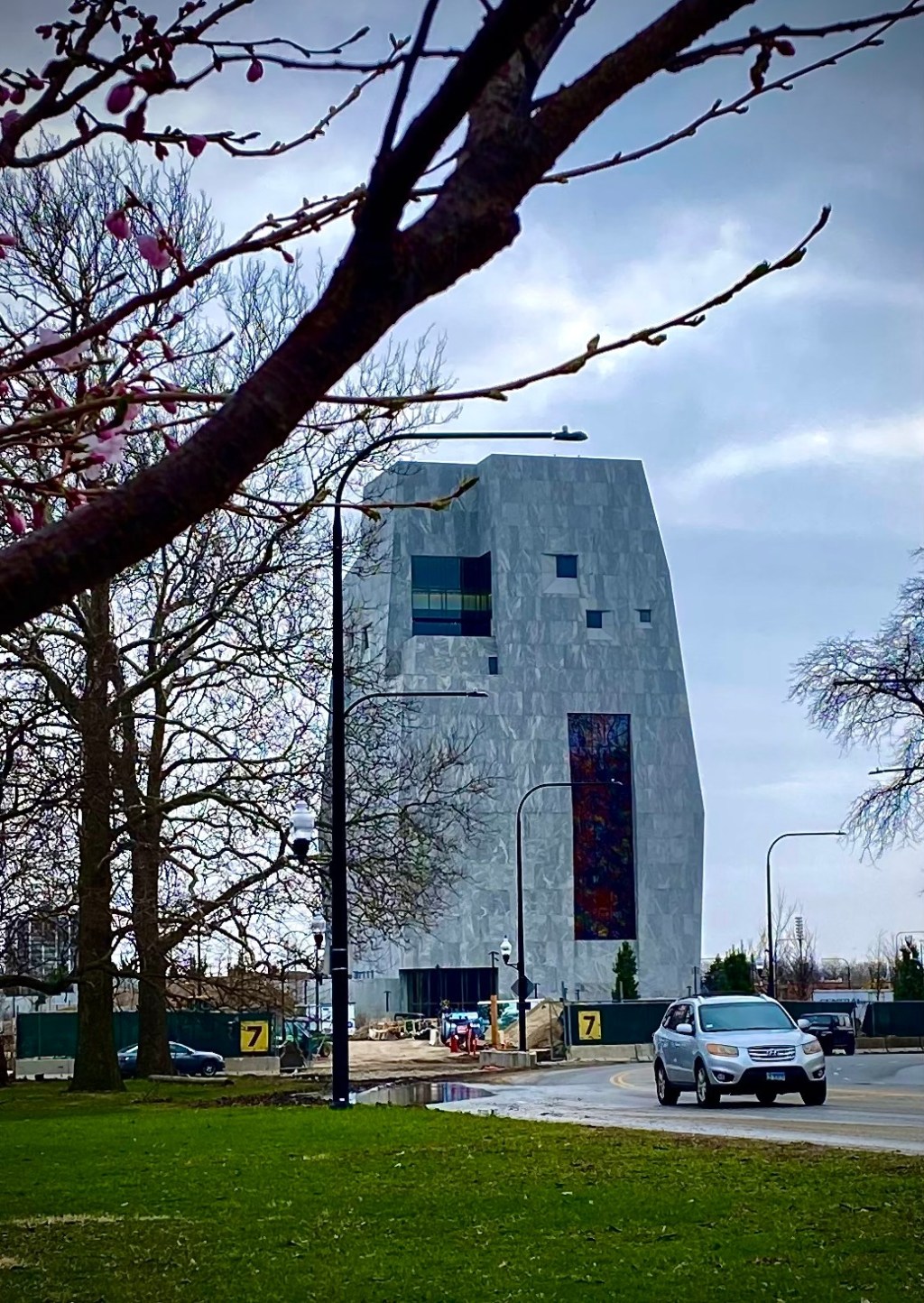
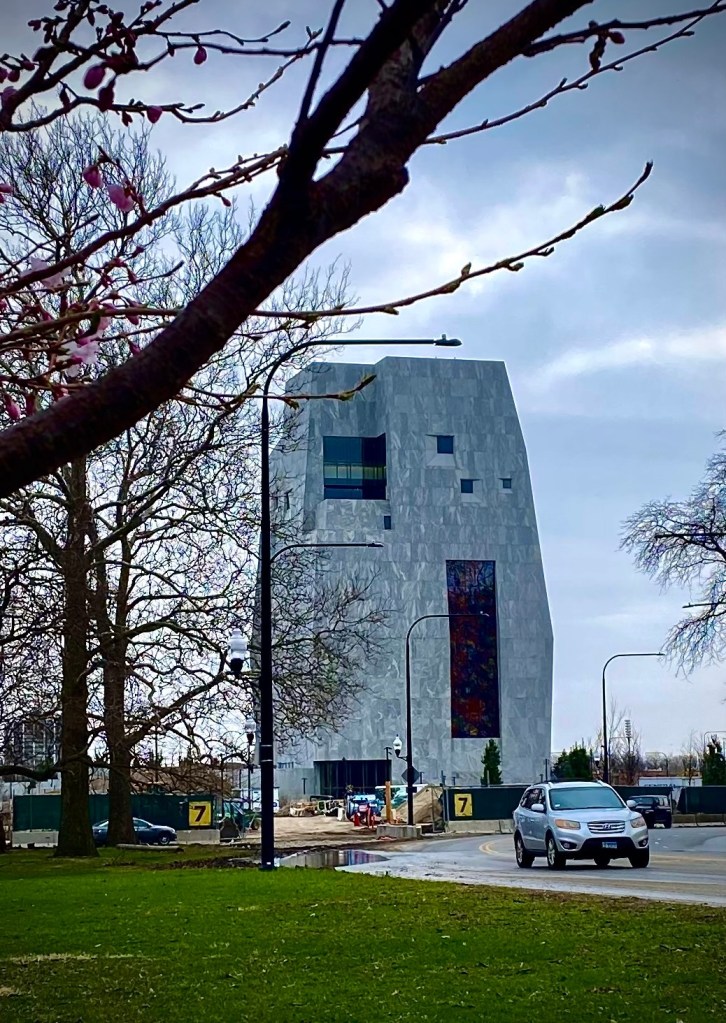
The bulky Brutalist monolith does not even pretend to fit in with the surrounding landscape. Among the Gothic university towers and several high-rise apartment buildings along the lakefront, the OPC defiantly leers at the neighborhoods below. Emblazoned on its gray facade are words from the President’s 2015 speech at Selma proclaiming, “YOU ARE AMERICA. UNCONSTRAINED BY HABIT AND CONVENTION. UNENCUMBERED BY WHAT IS, AND READY TO SEIZE WHAT OUGHT TO BE.” Perhaps the nonconformist architecture is supposed to represent an unabashed shattering of social barriers. Maybe it is a message of hope for young children on the South Side gazing up at the sky — a testament to the man who made it from those streets and proved what was possible. But alas, none of that will come to fruition if the surrounding residents are swept away by the tides of gentrification. From afar, they will barely be able to make out the shape of the Obama Presidential Center, much less the uplifting words inscribed on it.
As a result, a coalition of activists has demanded a community benefits agreement (CBA), a legally binding contract that would guarantee low-income housing and mandate local hiring. The Obama Foundation has refused, arguing that these activists do not “represent everybody on the South Side.” The former president himself added, “Next thing you know, you have got 40 or 50 organizations — all wanting to be decision makers.” But the diversity of stakeholders is hardly an excuse for refusing to engage at all.
This is not to say that the OPC will not breathe a fresh burst of life into our community. According to the City of Chicago, the center will generate $3 billion in economic impact and create 5,000 jobs. It is also more than just a museum. The complex will boast amenities including a community basketball court, Chicago Public Library branch, restaurants, playgrounds and gardens for people to enjoy mostly free of charge. All of these features on the 19-acre property, accompanied by the investments pouring in, are valuable assets that the community desperately needs. Yet without specific protections, the surge in capital will also engulf low-income residents in a deluge of rent hikes.
The Chicago City Council did pass the Jackson Park Housing Pilot Ordinance last fall, which reserves city-owned vacant lots near the OPC for affordable housing and expands tenant rights. This was hailed as a victory by the Obama CBA coalition after years of petitioning their local aldermen. But it is telling that the city’s taxpayers ended up footing the bill to protect themselves from displacement…by a privately-funded $850 million center.
It is not like these conflicts are particularly unprecedented for the South Side, either. The aforementioned University of Chicago contributes hundreds of millions of dollars in community benefit investment, empowers small businesses, conducts groundbreaking research and attracts legion intellectuals from around the world to Hyde Park. 101 Nobel laureates have hailed from the storied institution. At the same time, critics have also accused the university of aggressively expanding its real estate holdings to expedite gentrification of the surrounding area. If we can criticize the University of Chicago, why not the Obama Foundation? That is to say that both institutions undeniably exert positive social influences while simultaneously eroding sections of our community.
As harsh as it sounds, not even our hometown hero should be spared from scrutiny. President Obama certainly upended American politics by virtue of assuming the presidency as a Black man merely four decades after King’s assassination. This fact alone continues to endear many Americans to the 44th president, representing a sort of culmination of the civil rights movement. Yet we must separate the symbol from the substance and face some uncomfortable truths. The couple has secured a lucrative $65 million book deal for their memoirs, and the former president has raked in as much as $400,000 per speaking engagement. Black Americans, or all people of color for that matter, may have rightfully felt empowered by the sight of a man in the Oval Office who physically looked like them. Some may celebrate the Obamas’ post-presidential fortunes as a victory for the American Dream. But $65 million is a far cry from the median household income of $32,189 in Woodlawn, and the real impact that the Obama administration left on poor Black communities remains an open question. It turns out that the enduring quasi-populist image of Barack Obama is not necessarily bulletproof.
It is ironic that the “Obamalisk” bears the name of a community organizer who once prided himself in fighting for minority South Side residents. The cherished memory of Election Night 2008 — of hope and freedom, of Chicago’s favorite son emerging triumphant on that stage surrounded by his family — is fading fast. If Barack Obama truly cares about his legacy, he will understand that he cannot have it both ways. He cannot claim our communities for his humble origin story while abusing our steadfast trust in him to ignore local concerns. Without meaningful neighborhood engagement, the Obama Presidential Center will become a self-aggrandizing eyesore that merely uses us as a backdrop. The rugged block of gray will mark the grave of what once was the South Side of Chicago.


Leave a comment