

By Kieran Blake, Sports Editor
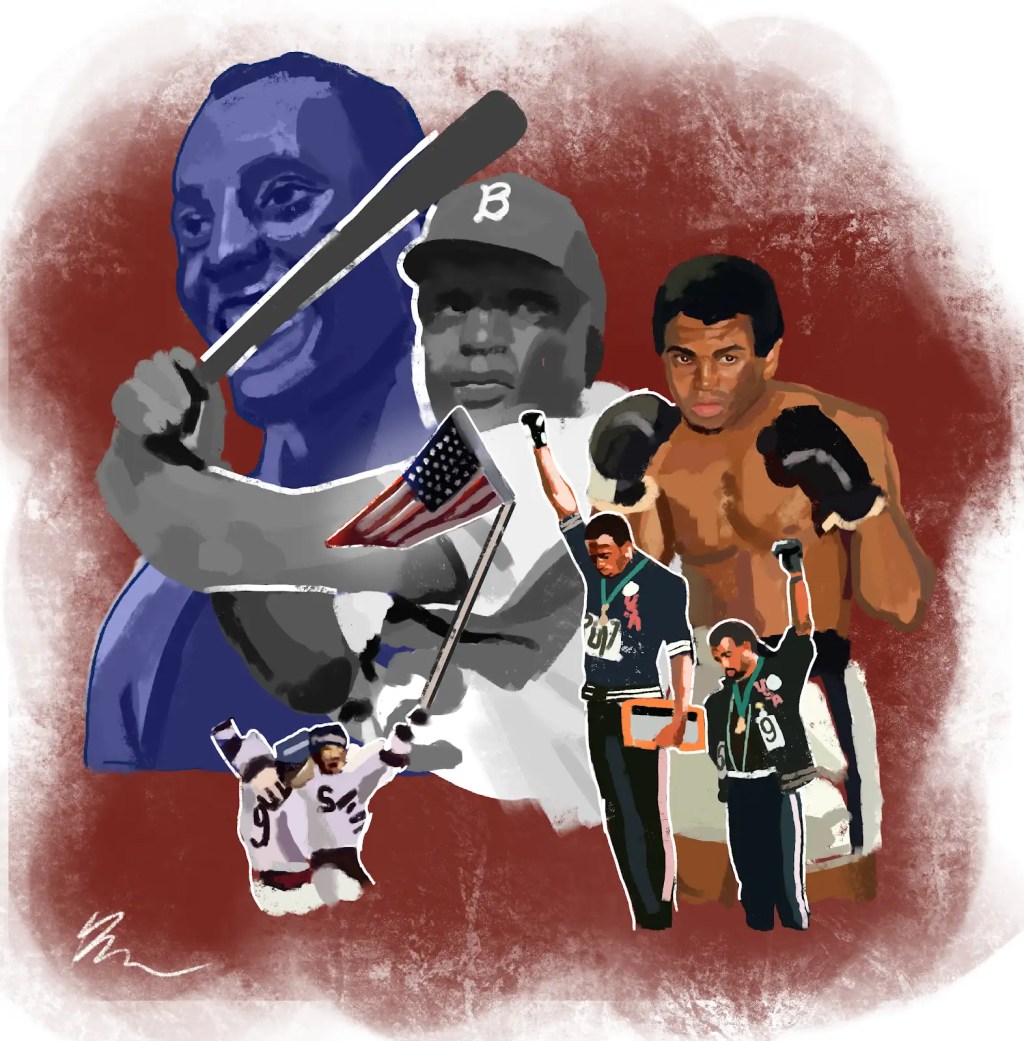
It’s 2024! Do you know what that means? It’s an election year! On Nov. 5, millions of Americans flocked to the polls and make a decision that could change the course of history: Kamala Harris or Donald Trump. This highly contentious race took up most of the newscycle in previous weeks, and the entire country caught a case of election fever. This pandemonium isn’t just limited to the political world; celebrities came out of the woodwork to endorse their respective candidates. Athletes are no different, whether that be WWE Hall of Famer Hulk Hogan tearing off his shirt at the Republican National Convention or Hall of Fame defensive end John Randle pledging Minnesota’s delegates to Harris at the Democratic National Convention. This intersection of sports and politics is nothing new and has been occurring for almost a century. Here are 16 notable instances in which athletes have impacted American history.
1936: Jesse Owens wins four golds in Berlin
The 1936 Olympics were supposed to be Hitler’s chance to showcase the supremacy of the Aryan race to the world. This plan backfired, as African-American athlete Jesse Owens dominated the track and field events, winning gold in the 100-meter, 200-meter, long jump and 4×100-meter relay. These victories humiliated Hitler and rendered Hitler’s purpose at the Olympics unfruitful while also becoming a defining moment in American cultural history.
1938: Joe Louis knocks out Max Schmeling in round one
While Owens may have defeated Hitler in track and field, German boxer Max Schmeling did defeat Joe Louis in the boxing events. In 1938, the two would face off in a rematch, this time on Louis’ home turf in New York City. While it had taken Schmeling 12 rounds to knock out Louis in 1936, Louis triumphantly knocked out Schmeling in the first round in 1938, again hindering Hitler’s attempts to showcase Aryan athletic superiority.
1942-45: Some of the biggest names in baseball go off to fight in World War II
When the U.S. entered World War II in 1941, it was all hands on deck. With millions of Americans being drafted into the military to fight, some of the most famous people in the country also decided to serve their country overseas. This included perhaps the two best baseball players in the league at the time: Joe DiMaggio of the New York Yankees (1943-45) and Ted Williams of the Boston Red Sox (1943-45). Some other future Hall of Famers who took a hiatus during their prime years included St. Louis Cardinal Stan Musial (1945), Detroit Tiger Hank Greenberg (1942-44), Cleveland Indian Bob Feller (1942-44) and New York Giant Johnny Mize (1943-45).
1947: Jackie Robinson breaks the color barrier
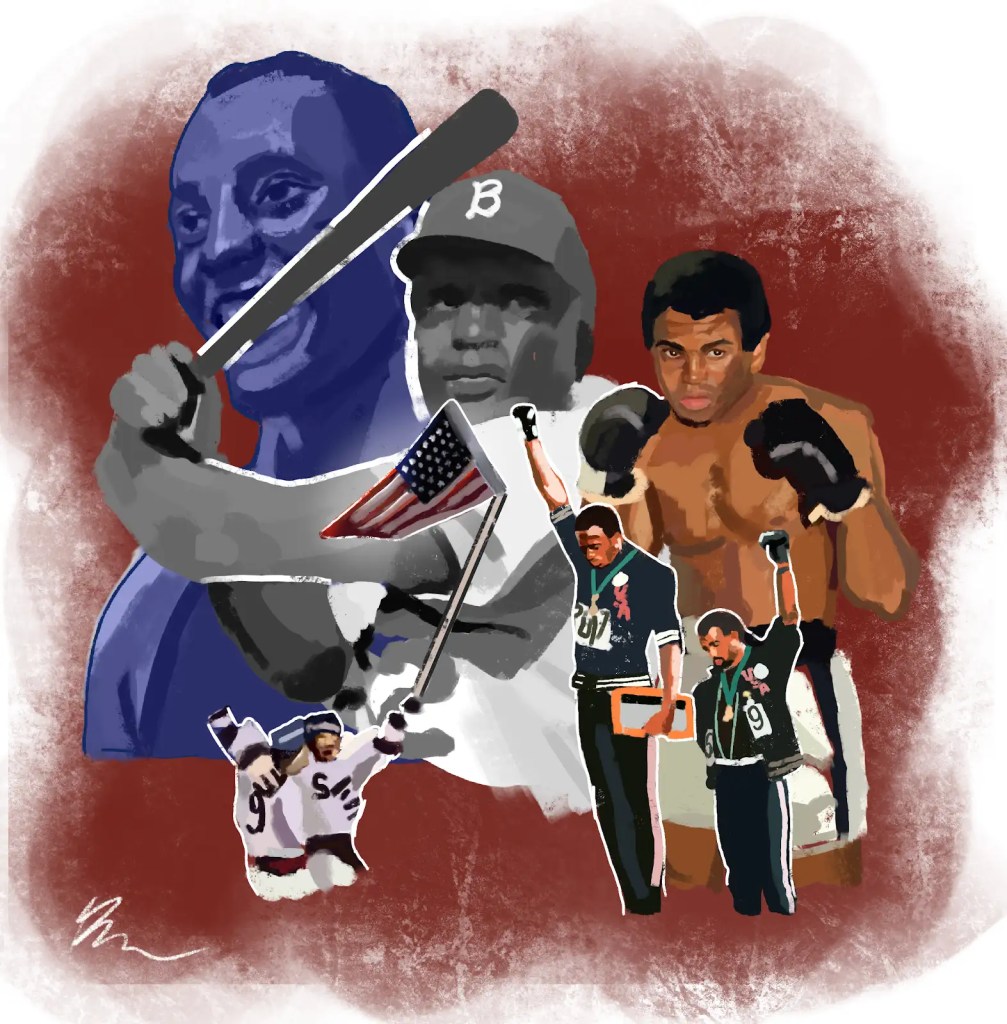
Another future Hall of Famer who served in World War II was a young infielder named Jackie Robinson. After serving, Robinson played a year in the Negro American League with the Kansas City Monarchs, before monumentally being signed by Brooklyn Dodgers manager Branch Rickey in 1947. Robinson was the first person of color to play in the MLB, and he broke down barriers for African Americans in baseball for years to come. This moment served as a turning point not just in sports history, but in civil right history and in American history.
1961: Bill Russell and six others boycott game
In October of 1961, three NBA players – Boston Celtics future Hall of Famers Sam Jones and Tom “Satch” Sanders and Atlanta Hawks rookie point guard Cleo Hill – were denied service at a coffee shop before a game in Lexington, Ky. Jones, Sanders and Hill responded by leaving Lexington and boycotting the game. They were joined in this boycott by reigning MVP Bill Russell, future Hall of Famer K.C. Jones and rookie point guard Al Butler from the Celtics, as well as former Rookie of the Year and one-time All-Star Woody Sauldsberry from the Hawks. This moment would showcase one of the many instances in which Russell would display his civil rights activism throughout his time in the league.
1966-67: “I ain’t got no quarrel with them Viet Cong”
By 1966, Muhammad Ali was considered by many to be the greatest boxer in the world. Public perception of him changed for many though when he refused to join the military and fight in Vietnam after being drafted. He was stripped of both his boxing license and his heavyweight championship and convicted of a felony. On June 4, 1967, 11 Black athletes (and one politician), including Russell, future NBA Hall of Famer Kareem Abdul-Jabbar (at the time known as Lew Alcindor), future NFL Hall of Famer Jim Brown and Ali himself gathered together in Cleveland, Ohio. Brown planned this meeting in order to defend Ali from criticism, and it came to be known as the “Cleveland Summit.” Ali would ultimately regain his license in 1971 after the Supreme Court ruled unanimously in his favor.
1968: Black Power salute in Mexico City
After winning gold and bronze, respectively, in the 200-meter, United States runners Tommie Smith and John Carlos famously stood on the podium with one of their arms raised while wearing a black glove on their raised hands as the national anthem played. This “Black Power” salute was met with great controversy around the world, but it remains a symbol of courage and defiance in the face of constant oppression. The silver medalist, Australia’s Peter Norman, was widely condemned throughout Australia for supporting the two men and wearing a human rights patch along with them.
1971: Ping-Pong Diplomacy
Throughout the Cold War, tensions between the U.S. and the People’s Republic of China were high. The two rarely engaged in diplomacy, and the relations between the two former allies had soured, with the U.S. refusing to recognize the Communist government. That all changed in 1971, when the U.S. table tennis team traveled to China in a highly publicized visit– the first of its kind since 1949. This visit then opened the door for President Richard Nixon’s visit to China the next year, which was instrumental in relieving some of the lingering Cold War tensions between the two countries.
1973: The Battle of the Sexes
As feminist movements were ongoing in 1973, men’s tennis legend Bobby Riggs came out of retirement to challenge women’s tennis icon Billie Jean King. After King declined, Riggs faced off against top women’s player Margaret Court, beating her 6-2 and 6-1 in what was dubbed as the “Mother’s Day Massacre.” Following Court’s loss and in response to taunts from an arrogant Riggs, King accepted the challenge and the two faced off in the highly publicized “Battle of the Sexes.” Despite many favoring Riggs, King humiliated Riggs in straight sets: 6-4, 6-3 and 6-3, respectively, and would go down in history as a feminist icon.
1980: The Miracle on Ice
The 1980 Winter Olympics were held in Lake Placid, New York. On Feb. 22, the U.S. men’s ice hockey team faced off against the heavily favored Soviet Union. The two countries had been pitted against each other in the Cold War for over 30 years at this point, and this match was a culmination of that rivalry. Spurred on by the inspiring words of coach Herb Brooks, the U.S. team shocked the world in what would go down in history as one of the biggest upsets ever in sports. After being down 3-2 entering the third period, the U.S. came back and went up 4-3 with ten minutes to go. As the final buzzer sounded, the world looked on in awe as the U.S. players skated across the ice in celebration and announcer Al Michaels delivered the now famous call: “Do you believe in miracles?”
1980: 65 countries boycott the Olympics:
In 1979, the Soviet Union launched an invasion into Afghanistan. This invasion was condemned worldwide, especially by President Jimmy Carter, who called it a violation of human rights. Sanctions were imposed by many groups and countries, and when the 1980 Summer Olympics were hosted in Moscow, the U.S. led 65 countries in a boycott of the games. Many other countries sent limited delegations. An angry U.S.S.R. would later lead the Eastern Bloc in a boycott of the 1984 games when they were held in Los Angeles.
1996: Mahmoud Abdul-Rauf refuses to stand during the national anthem
Well before there was Colin Kaepernick, there was Mahmoud Abdul-Rauf. Chris Jackson had been one of the most prolific scorers in college basketball history at LSU, making two All-American teams and being drafted third overall in 1990 by the Denver Nuggets. He then converted to Islam and, in 1993, changed his name to Mahmoud Abdul-Rauf. In 1996, he refused to stand during the national anthem as a means of protesting what he viewed as “a symbol of oppression, of tyranny.” He received death threats and was suspended. He eventually agreed to stand, bow his head and pray during the anthem. Still, Abdul-Rauf was out of the league by 1998, aside from a short-lived return in 2001.
2004: Pat Tillman dies in Afghanistan
When President George W. Bush announced his “War on Terror” in the wake of the Sept. 11 attacks, Arizona Cardinals safety Pat Tillman turned down a new contract in 2002 and enlisted in the army. The football world embraced Tillman as a hero and a patriot, and he was honored with the Arthur Ashe Courage Award at the 2003 ESPYs. Tillman would sadly never play in the NFL again, as on April 22, 2004, Tillman was killed as the result of friendly fire in Afghanistan. Tillman was posthumously honored with numerous medals by the army, receiving a Silver Star and a Purple Heart, and he was inducted into the Cardinals Ring of Honor, his number 40 being retired by the team.
2014: “Hands up, don’t shoot”
On Aug. 9, 2014, Officer Darren Wilson fired multiple fatal shots at Michael Brown, an 18-year-old Black man, in Ferguson, Missouri. The shooting incited civil unrest and riots throughout the country. Protests against police brutality erupted in the streets, and violence ensued. On Nov. 30, 2014, five St. Louis Rams players – Tavon Austin, Stedman Bailey, Kenny Britt, Jared Cook and Chris Givens – ran out onto the field with their hands up as a form of protest. The St. Louis Police Officers Association condemned the action, but the NFL refused to punish the players for their actions.
2016: Colin Kaepernick takes a knee
In one of the most famous protests in sports history, San Francisco 49ers star quarterback Colin Kaepernick took a knee to protest against police brutality during the national anthem before the 49ers’ final preseason game on Sept. 1, 2016. He was joined in protest by safety Eric Reid and by more players as the regular season began. Following his release by the 49ers that offseason Kaepernick was never signed by another NFL team again. The backlash that Kaepernick faced effectively locked him out of the league. President Donald Trump later called for all protesting players to be fired in 2017. This led to massive protest by hundreds of NFL players and executives during which they kneeled during or before the national anthem.
2020: Black Lives Matter
On May 25, 2020, as the COVID-19 pandemic raged on, Minnesota police officers were filmed using excessive force on a 46-year-old Black man by the name of George Floyd. The videotape showed Officer Derek Chauvin kneeling on Floyd’s neck for almost 10 minutes, with Floyd pleading to him: “I can’t breathe.” Floyd’s dying words would become a rallying cry for protestors as protests and riots erupted across the U.S., with buildings being set on fire while protestors and police engaged in often-violent clashes. This, coupled with the shooting of Breonna Taylor in her home by police in March of that year, spurred many to take to the streets and voice their support for the Black Lives Matter movement. Many athletes voiced their support for or participated in the protests as well, including LeBron James, Stephen Curry, Coco Gauff, Tom Brady and Serena Williams.
![[Photo Gallery] Latin American Coalition Compass](https://paytonpawprint.com/wp-content/uploads/2026/10/laccompass-01-of-13.jpg?w=1024)


Leave a Reply