

By Elena Whitford, Features Editor
In 1974, a group of Highland Park teenagers, most still attending high school, came together to put on a play in a church basement. The following year, they became a nonprofit, named themselves after a book one of them was reading, and officially produced their first season of plays (in another church basement) as Steppenwolf Theatre Company.
In the fifty years since, much has changed at Steppenwolf. They have shifted to real theaters, for one, having built their current space at 1650 N Halsted Ave in Old Town in the early 1990s. They have premiered now-world-famous plays that frequently end up on Broadway (Brandon Jacobs-Jenkins’ “Purpose” swept the Tony and Pulitzer awards last year after its world premiere in Steppenwolf’s 2023-24 season). As for their ensemble members — names like John Malkovich, Carrie Coon, and Gary Sinise — they have skyrocketed to global superstardom.
Still, much has stayed the same. For one, Steppenwolf has maintained its characteristic brash, courageous style, lovingly caricatured as “chair-throwing” by amateur fans of Chicago theater. The description, while silly, is not far off. As artistic directors Glenn Davis and Audrey Francis put it, Steppenwolf is “an artist-driven theatre, whose vitality is defined by its appetite for bold and innovative work.”
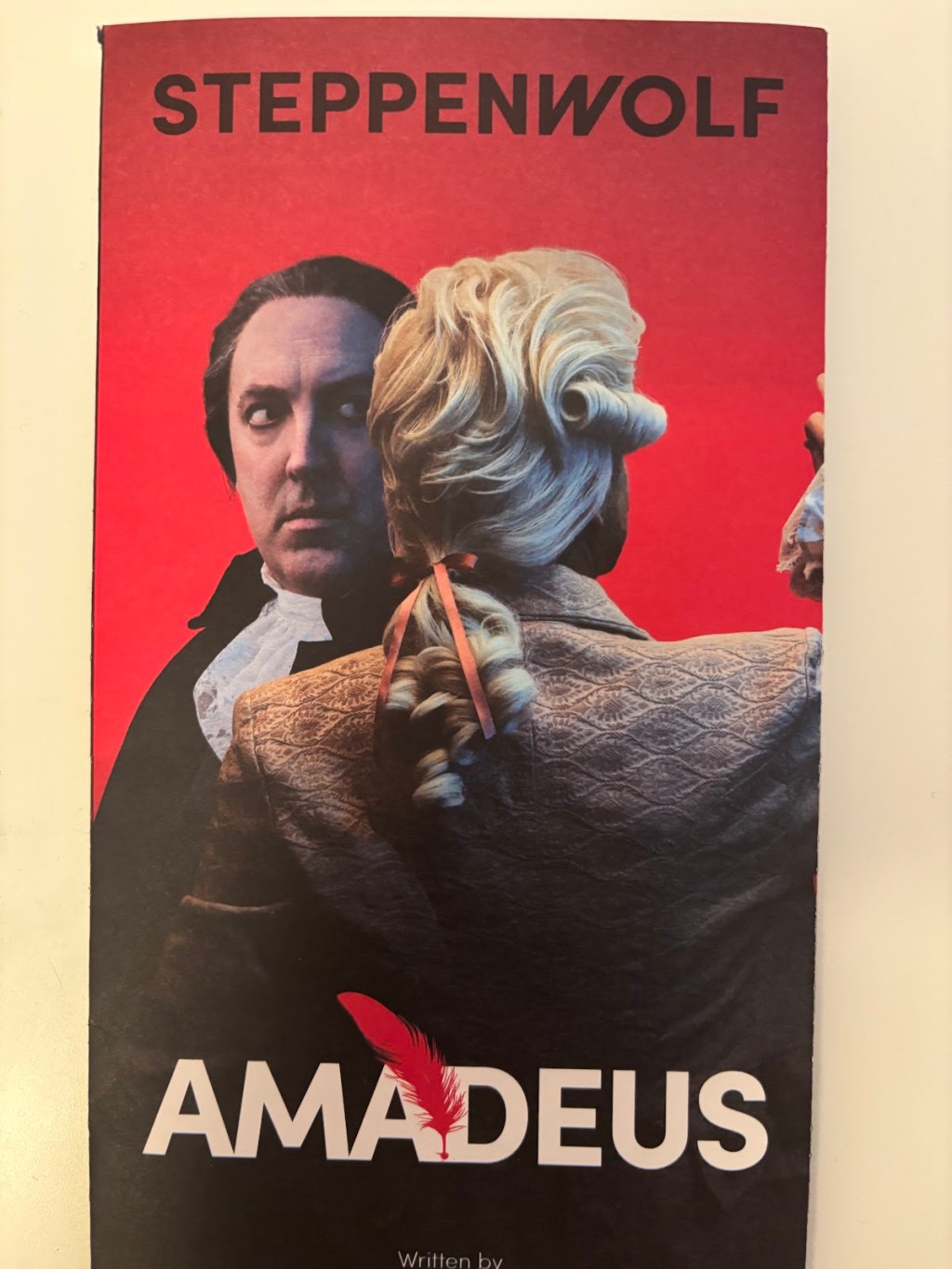
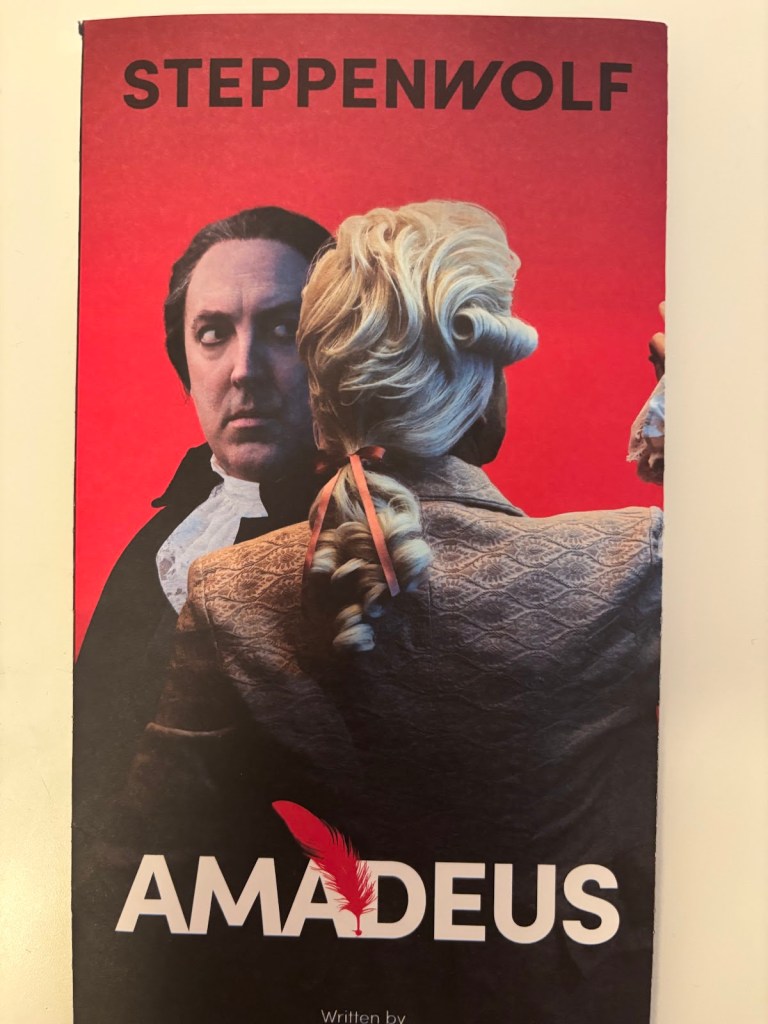
That quote appears in the program for their production of Peter Shaffer’s play “Amadeus,” which ran from Nov. 6, 2025 to Jan. 25, 2026, having been extended twice. Written in 1979, the play is nearly as old as Steppenwolf itself, and this production, directed by the acclaimed Robert Falls, brought ensemble members Ian Barford and Robert Breuler back to Steppenwolf after they primarily acted in 1990s and 2000s productions, marking a capstone of the theater’s work in the 50 years leading up to this moment.
With that in mind, how is the play itself? A January performance I attended was nothing short of spectacular. Steppenwolf has mounted several shows in their in-the-round Ensemble Theater, built in 2021, but perhaps none is better suited to the format than “Amadeus.”
The play centers (literally, in this case) around Wolfgang Amadeus Mozart as he skyrockets to fame and eventually descends into poverty in 18th-century Vienna, all from the perspective of his fellow composer Antonio Salieri. Salieri, who has dedicated his life to being a good composer, envies Mozart, the young prodigy who hardly tries yet nevertheless produces music fit for gods. The play is equally about jealousy as it is with learning how to contend with sheer beauty.
And fittingly, what a beautiful play it is. The costumes are stunning and just on the right side of ahistorical, while the sparse set is framed by a large fresco ceiling complete with broken windows. Some of the images from the show continue to live in my head a month after seeing it. I found myself leaning as far forward as I could during several scenes, including one near the end of the first act in which pages upon pages of musical notation fall from the heavens (this, like most other scenes, is amplified by Mozart’s music echoing throughout the theater’s surround sound system). I have seen many good plays, but “Amadeus” is one of the few that have left me breathless.
“Amadeus” is also so affecting because its message is ultra-specific yet somehow still universal. Jonah Newton, a junior at William Howard Taft High School, is a teen curator — a position hired from Steppenwolf’s Young Adult Council to bring a younger voice to educational activities. “We work with the Steppenwolf Education department to help build curriculum for the department to go to schools [and] for the kids to come to see the shows at Steppenwolf,” Newton said.
Working with “Amadeus” was a challenge for Newton because of the play’s multitude of themes. The education team first considered developing a lesson plan around music before realizing that “teens are really gonna associate with the jealousy that Salieri has. So instead of incorporating the musical aspect, we incorporated stuff that connects with the teens more,” said Newton. “Only a few teens really interact with the musical side of things. But everyone relates to being jealous.”
Though Payton student Ivy Lefebvre ‘27, another Young Adult Council member, had not previously given “Amadeus” more than a passing thought. When they heard Steppenwolf would produce the play, they said, “I thought, oh, that old movie my mom likes.” The production far exceeded their expectations.
“To take the connotations that it had as a biopic about an old guy and to be like, well, what’s the core of the story? It’s about this beautiful world. That’s what makes it interesting. You couldn’t just do the movie from that,” Lefebvre said.
Compared to other shows at Steppenwolf, both agreed “Amadeus” was more dramatic. Newton described its message as “keep your friends close, keep your enemies closer.”
Lefebvre said it was “bigger” and “went more bombastic than, like, let’s talk about feelings. The feeling is ‘bedazzled,’ and that’s good.”
Beyond the sheer maximalism, though, is an important social message. “It’s a very chaotic time right now. And there are so many things going on in the world that we really need a break,” Newton said. “‘Mr. Wolf’ and ‘Amadeus’ and even ‘The Dance of Death’ [the first three shows in Steppenwolf’s 2025-26 season] outline things that are inherently wrong with the world. But they are stories about people and not yourself, so you are allowed to escape into that world and still think about things that are going on.”
In these ways, “Amadeus” proves Steppenwolf can stick to past traditions while pushing forward into new frontiers. If you are a theater geek or anyone with a passion for well-made art, keep your eye on Steppenwolf because they are not stopping anytime soon.







Leave a comment